
8th Pay Commission Salary Calculator & Fitment Factor
Your Official 8th CPC Salary Breakdown
7th vs 8th Pay Quick View & How This Works
Our calculator simplifies the transition between pay commissions. It takes your base pay from the 7th CPC, applies the 1.92 official fitment factor to find your new base, zeros out the old DA, and automatically assigns the newly restructured HRA and TA values based on your city class and exact pay level group.
What is the 8th Pay Commission?
What is 8th pay commission salary? The 8th pay commission salary is the revised compensation structure for Indian Central Government employees, effective January 2026. It merges the previous basic pay and the accumulated Dearness Allowance (which had surpassed 50%) into a newly elevated base pay using a standardized fitment factor.
In India, a Central Pay Commission (CPC) is constituted roughly every 10 years to revise the salary structure, allowances, and pensions to keep up with inflation. Following the historic schedule, this restructuring creates a massive boost in base pay, which in turn recalculates and increases your HRA, TA, and future pension benchmarks.
If you want to view the broader financial ecosystem, you can return to our homepage to explore all calculators.
Who Should Use This Calculator?
This tool is designed for the over 1 crore central government employees, armed forces personnel, and pensioners who rely on this new framework. It applies to Group A, B, and C employees across all ministries and departments.
State government employees can also use this as an estimate, as most states adopt the CPC recommendations.
How is Salary Calculated Under the 8th CPC?
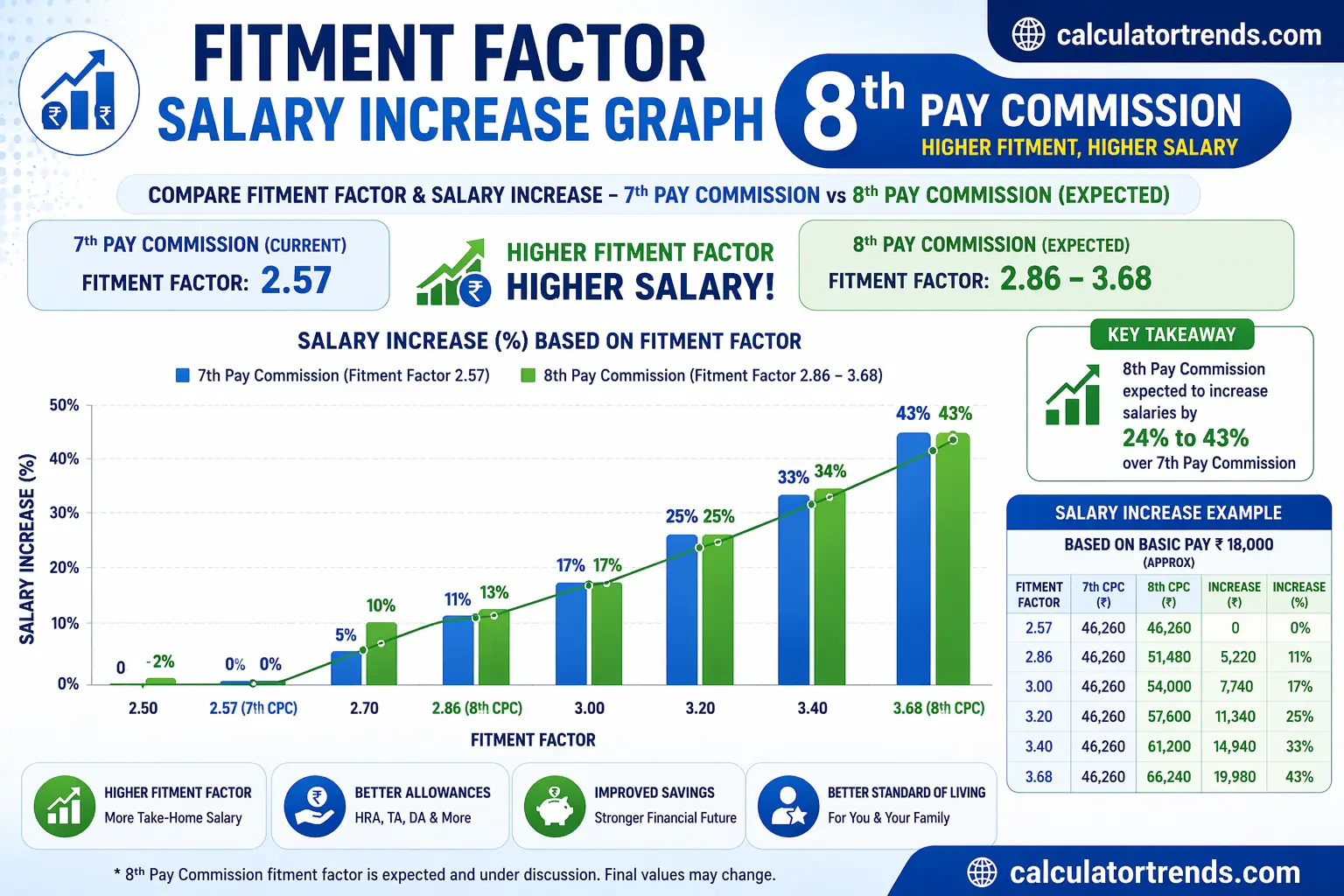
How salary is calculated? Salary under the 8th CPC is calculated by multiplying your old 7th CPC basic pay by the official fitment factor (1.92). This yields your new basic pay. Allowances like HRA (10%, 20%, 30%) and TA are then recalculated based on this new elevated basic pay, while the old DA is reset to zero.
If you're curious about how the multiplier changes your specific bracket, use fitment factor calculator to test different increment scenarios and historical comparisons.
| Component | 8th CPC Rule (Effective Jan 2026) |
|---|---|
| Fitment Factor | The baseline fitment factor is 1.92. (New Basic = Old Basic × 1.92) |
| Dearness Allowance (DA) | The prevailing DA (exceeding 50%) was fully absorbed. DA reset to 0%. |
| House Rent Allowance (HRA) | Shifted to new percentage tiers based on city class: X City (30%), Y City (20%), Z City (10%). |
| Transport Allowance (TA) | Fixed amounts based on pay level and city. DA is no longer added to TA since DA is reset to 0%. |
Expected Salary Increase: Nominal vs. Real Increase
Expected salary increase: While the nominal gross salary appears to increase by nearly 92% due to the 1.92 multiplier, the expected real salary increase in actual take-home pay ranges between 25% to 35% after accounting for the absorption of previously high Dearness Allowance.
For example, if your old basic was ₹30,000, your new basic becomes ₹57,600. But since you were already receiving over ₹15,000 in DA previously, the real financial jump is felt in the compounding of future allowances.
Step-by-Step Salary Calculation Guide
To accurately determine your new take-home pay, follow these steps using our tool above:
- Step 1: Find your baseline. Enter your exact final Basic Pay as of December 2025. If you aren't sure what it was, calculate your 7th pay salary first to find your starting point.
- Step 2: Apply Fitment Factor. Our tool automatically multiplies your base by 1.92.
- Step 3: Select City Tier. Choose X, Y, or Z to accurately map your new HRA (30%, 20%, 10%).
- Step 4: Review Deductions. The calculator subtracts standard NPS deductions to give you an estimated net pay.
7th Pay vs 8th Pay Quick Comparison
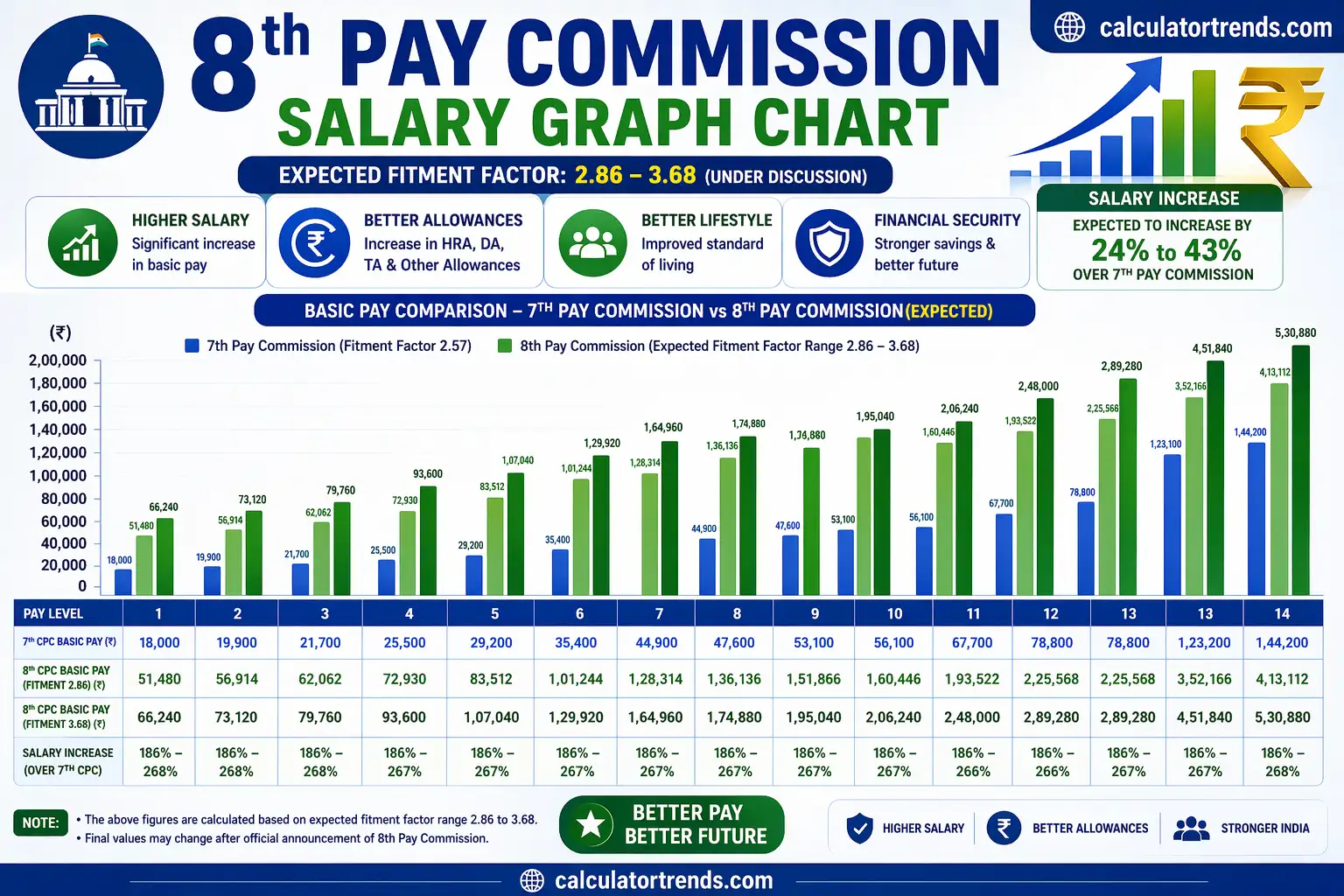
The transition between commissions fundamentally alters the pay matrix structure. If you want to dive deep into historical charts and full breakdowns, compare 7th vs 8th pay on our detailed comparison page.
| Pay Level | Prior Minimum Basic (7th CPC) | Official Minimum Basic (8th CPC) |
|---|---|---|
| Levels 1 to 5 (Group C) | ₹18,000 | ₹34,560 |
| Levels 6 to 9 (Group B) | ₹35,400 | ₹67,970 |
| Levels 10 to 12 (Group A) | ₹56,100 | ₹1,07,710 |
Real Example: Level 6 Employee Calculation
Let’s look at a practical example of a Level 6 employee (e.g., an Assistant or Sub-Inspector) residing in an X-Class city (Metro):
- Old 7th CPC Basic: ₹35,400
- New 8th CPC Basic (x 1.92): ₹67,970
- New HRA (30% for X City): ₹20,391
- New Transport Allowance (TPTA City): ₹3,600 (Base, with 0% DA)
- New Estimated Gross Salary: ~₹91,961
This illustrates how a simple basic pay bump significantly enhances HRA payouts, pushing the gross salary closer to the 1 Lakh mark for mid-level employees.
Frequently Asked Questions (2026 Update)
When was the 8th Pay Commission implemented?
Maintaining the historical 10-year cycle of Central Pay Commissions, the 8th CPC modifications officially went into effect starting January 1, 2026.
What happened to the accumulated Dearness Allowance (DA)?
Upon the implementation of the new Pay Commission, the existing Dearness Allowance (which had surpassed 50%) was completely absorbed into the newly revised Basic Pay. The DA percentage officially reset to 0% at the start of 2026.
How is Transport Allowance (TA) calculated in the tool?
TA is determined by your Pay Level and City classification. TPTA cities (like Delhi and Mumbai) yield higher fixed TA payouts compared to 'Other' cities. Because DA reset to 0%, the initial 2026 TA payout consists purely of the base fixed amount without DA multipliers.