
8th Pay vs 7th Pay Commission Salary Comparison Calculator
Calculate the exact difference between your current 7th CPC salary and your expected 8th CPC salary based on the projected 1.92 fitment factor, revised HRA, and DA adjustments.
Salary Comparison Tool
What is the 7th Pay Commission?
The 7th Central Pay Commission (CPC) was implemented on January 1, 2016, restructuring the salary, allowances, and pension systems for central government employees in India. It introduced the pay matrix system, replacing the older pay band and grade pay system. If you want to know your exact current standing, you can calculate your 7th pay salary directly using standard metrics.
What is the 8th Pay Commission?
The 8th Pay Commission is the upcoming wage revision committee, expected to be implemented starting January 1, 2026. Because Dearness Allowance (DA) crossed the critical 50% threshold in early 2024, the formation of the 8th CPC has become necessary to merge DA into basic pay, revise allowances, and adjust the fitment factor against inflation. You can project your future earnings by using the check 8th pay salary calculator.
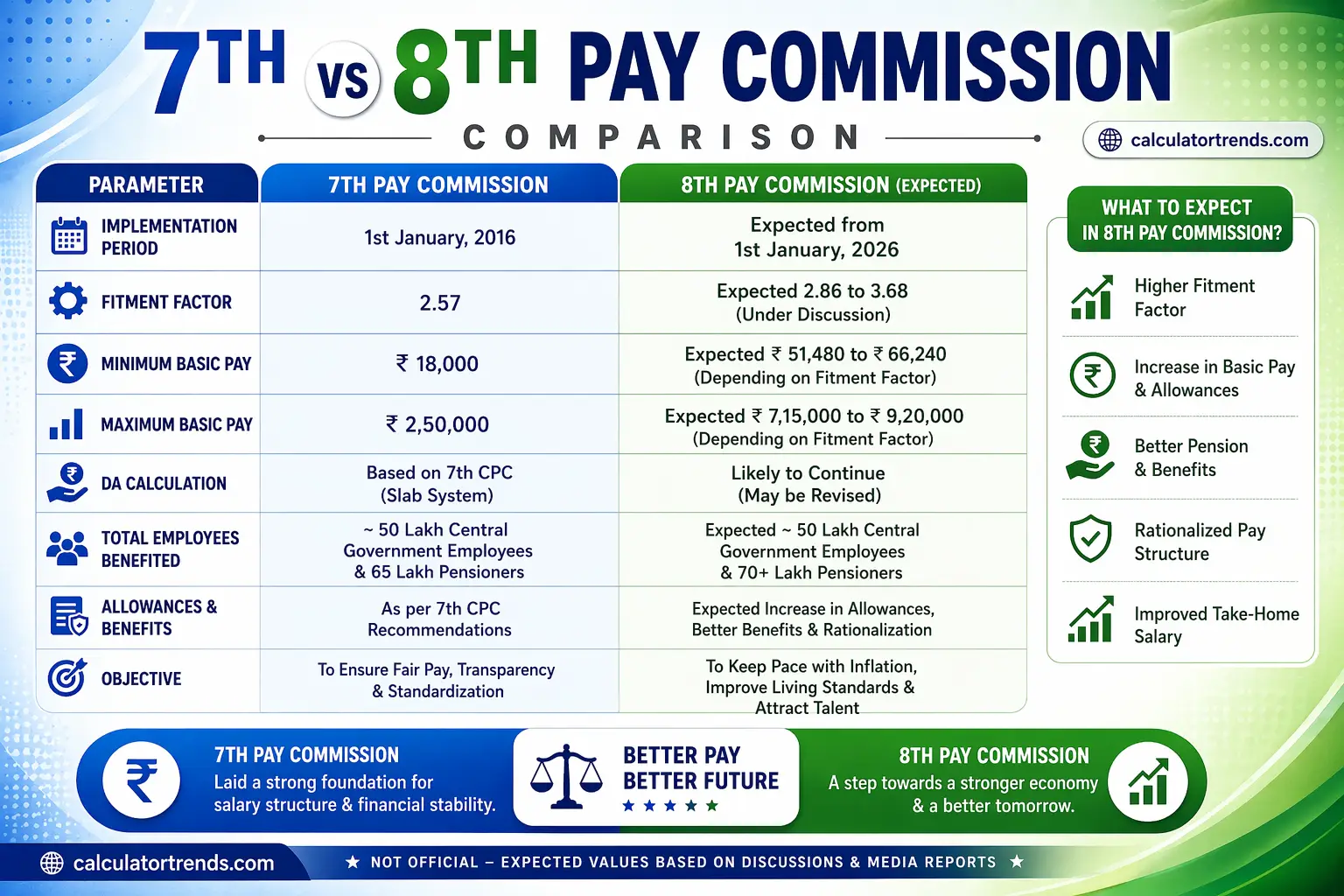
Key Differences (7th vs 8th)
The transition between commissions relies heavily on merging existing inflation allowances and resetting the baseline. The key AEO (Answer Engine Optimization) differences include:
- Basic Pay Structure: 8th CPC will merge the 50%+ DA into the current Basic Pay, establishing a new minimum wage (expected to rise from ₹18,000 to approximately ₹34,560).
- Dearness Allowance Reset: In the 7th CPC, DA is currently high. Upon the 8th CPC implementation, DA will reset back to 0%.
- Fitment Factor: The multiplier used to transition salaries will change from 2.57 (in 7th CPC) to an estimated 1.92 or higher.
- Allowance Slabs: Allowances like HRA will be readjusted upward to account for the new baseline.
Salary Comparison Table (Example at Level 1)
| Component | 7th Pay (Current) | 8th Pay (Estimated) | Difference |
|---|---|---|---|
| Basic Pay | ₹18,000 | ₹34,560 | + ₹16,560 |
| DA | ₹9,000 (50%) | ₹0 (0%) | - ₹9,000 |
| HRA (Z City) | ₹1,800 (10%) | ₹3,456 (10%) | + ₹1,656 |
| Est. Gross | ₹30,150 | ₹39,744 | + ₹9,594 |
Fitment Factor Explained
The "fitment factor meaning" is simple: it is a universal multiplier used by the government to revise the pay matrix across all levels without calculating each cell manually. For the 7th CPC, a uniform fitment factor of 2.57 was applied. For the 8th CPC, employee unions are demanding a factor of 2.86 or 3.68, though financial estimates place the most likely realistic multiplier around 1.92.
To test different multiplier scenarios on your salary, use fitment factor calculator.
Allowances Comparison (DA, HRA, TA)
Allowances undergo significant restructuring during a new pay commission:
- House Rent Allowance (HRA): Under the 7th CPC, HRA caps were 27%, 18%, and 9% (for X, Y, Z cities). The 8th CPC is expected to bump these up to 30%, 20%, and 10% to combat rising real estate costs.
- Transport Allowance (TA): TA is expected to be recalibrated. Rather than keeping fixed minimums of ₹900 or ₹1350, the baseline TA will scale up proportionally with the new fitment factor.
Expected Salary Increase in 8th Pay (2026)
If you are wondering about the "expected salary increase in 8th pay," our analysis suggests an overall gross salary increase ranging from 15% to 25% depending on your pay band and city category. While the Basic Pay practically doubles, the reset of DA balances out the extreme spike, resulting in a healthy but controlled net increase in take-home pay.
Who Will Benefit the Most?
Entry-level employees (Level 1 to Level 5) typically see the highest percentage impact on their take-home salaries due to the upward revision of minimum baseline wages and minimum fixed allowance limits. State government employees, such as those in Uttar Pradesh, usually adopt the Central Pay Commission structures shortly after the center..
Frequently Asked Questions (FAQs)
What is the expected difference between 7th and 8th Pay Commission?
The primary difference is the merging of the 50% DA into the Basic Pay to create a new minimum wage, along with a fitment multiplier (likely 1.92) to adjust against inflation from 2016 to 2026.
Will DA become zero in the 8th Pay Commission?
Yes, historically, when a new Pay Commission is implemented, the existing Dearness Allowance is absorbed into the new Basic Pay, and DA calculations reset to 0%.
When will the 8th CPC be implemented?
The 8th Central Pay Commission is legally slated to be implemented from January 1, 2026, maintaining the 10-year cycle of wage revisions for government employees.