
Fitment Factor Calculator (7th & 8th Pay Commission)
Instantly calculate your revised basic pay based on the fitment factor formula. Compare current 7th CPC standards with the expected 8th Pay Commission projections.
7th vs 8th Pay Quick View & How This Works
Our calculator simplifies the transition between pay commissions. It takes your base pay from the 7th CPC, applies the 1.92 official expected fitment factor to find your new base, zeros out the old DA, and helps you estimate your new compensation structure instantly.
1. What is Fitment Factor?
The fitment factor is a multiplication number used by Pay Commissions to arrive at the revised basic pay of employees. It acts as a standard multiplier applied to an employee's existing basic pay to calculate their new salary under a revised pay structure.
Instead of manually calculating inflation, dearness allowance mergers, and real wage hikes separately for millions of employees, the government consolidates these metrics into a single fitment factor formula.
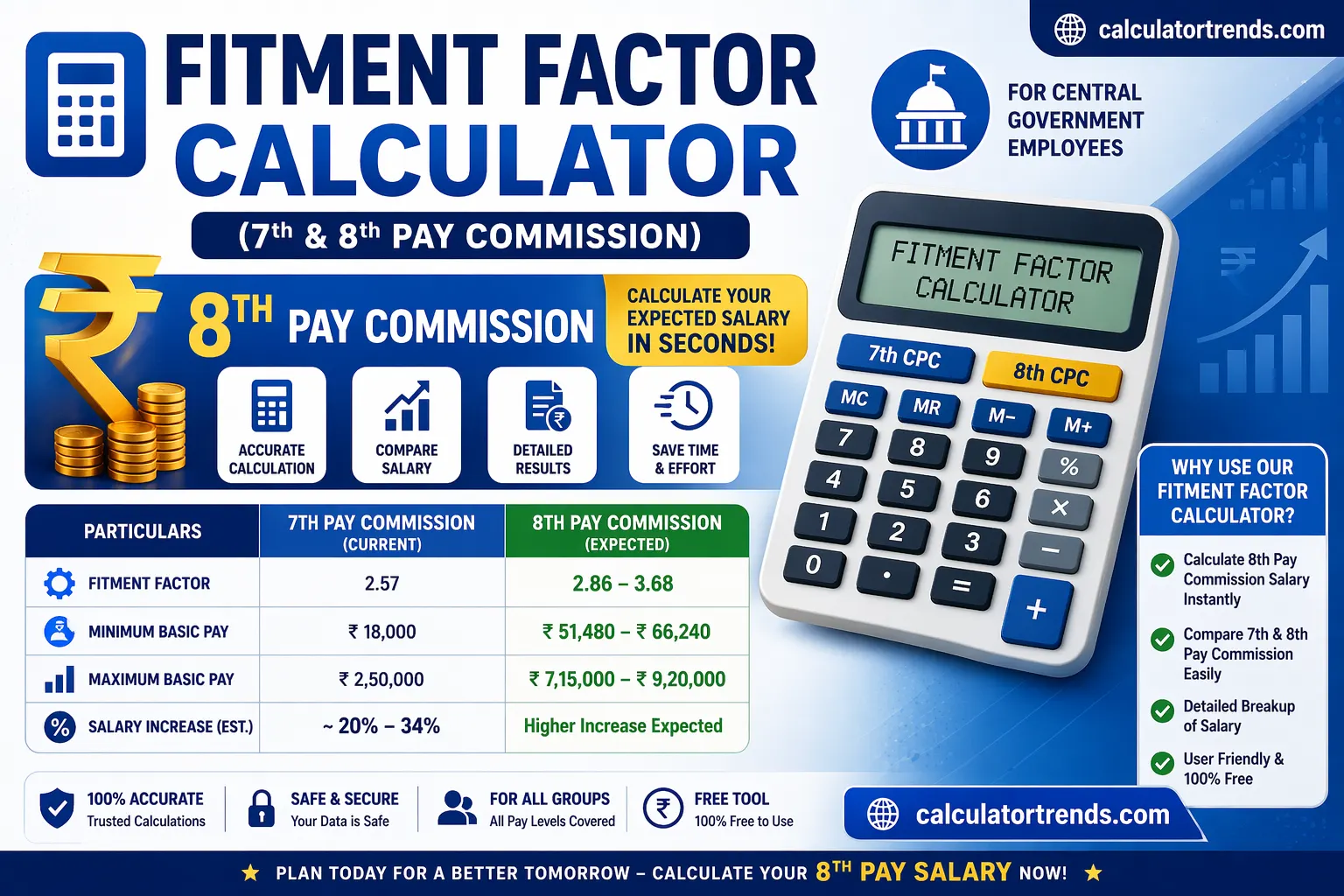
2. Fitment Factor in 7th Pay Commission (2.57)
During the implementation of the 7th Central Pay Commission (CPC) in 2016, the government established a uniform fitment factor of 2.57 for all categories of employees.
- Minimum Wage Impact: It raised the minimum basic pay from ₹7,000 (6th CPC) to ₹18,000.
- Calculation Base: It absorbed the existing Dearness Allowance (which was 125% at the time) into the base pay.
If you need to verify your exact current salary structure, use 7th pay salary calculator to break down your allowances and deductions.
3. Expected Fitment Factor in 8th Pay Commission (~1.92)
With the 8th Pay Commission anticipated for implementation around January 2026, employee unions are advocating for a higher fitment factor. However, financial experts and historical data suggest a likely multiplier.
The expected 8th CPC fitment factor is 1.92. Here is why:
- DA Merger: By 2026, DA is expected to cross 50% (potentially reaching 55-60%). The 1.92 factor accounts for absorbing this high DA into the basic pay.
- Real Wage Hike: It provides a real wage increase of approximately 20% to 25% over the inflation-adjusted pay.
- Minimum Basic Projection: Applying 1.92 to the current minimum of ₹18,000 projects a new minimum basic pay of roughly ₹34,560.
To see detailed breakdowns of projected allowances, check 8th pay calculator to estimate your future take-home pay.
4. How to Calculate Salary using Fitment Factor
The salary increase calculation using the fitment factor is straightforward. Follow this formula:
Step-by-Step Guide:
- Identify your exact Current Basic Pay (excluding HRA, DA, or TA).
- Determine the applicable Fitment Factor (e.g., 2.57 for 7th CPC, 1.92 for expected 8th CPC).
- Multiply the two figures together.
- Round off the result to the nearest hundred to get your new position in the pay matrix.
5. Example Calculation
Let's look at how the basic pay transforms across commissions for an employee currently drawing ₹35,000 as basic pay.
| Scenario | Base Amount | Multiplier | New Basic Pay |
|---|---|---|---|
| 6th to 7th CPC | ₹13,500 | 2.57 | ₹34,695 (~₹35,000) |
| 7th to 8th CPC (Est.) | ₹35,000 | 1.92 | ₹67,200 |
Want a deeper analysis of these transitions? You can compare 8th vs 7th pay commission matrices on our dedicated comparison page.
6. Impact on Salary Increase
The fitment factor doesn't just change your basic pay; it dictates your entire gross salary structure.
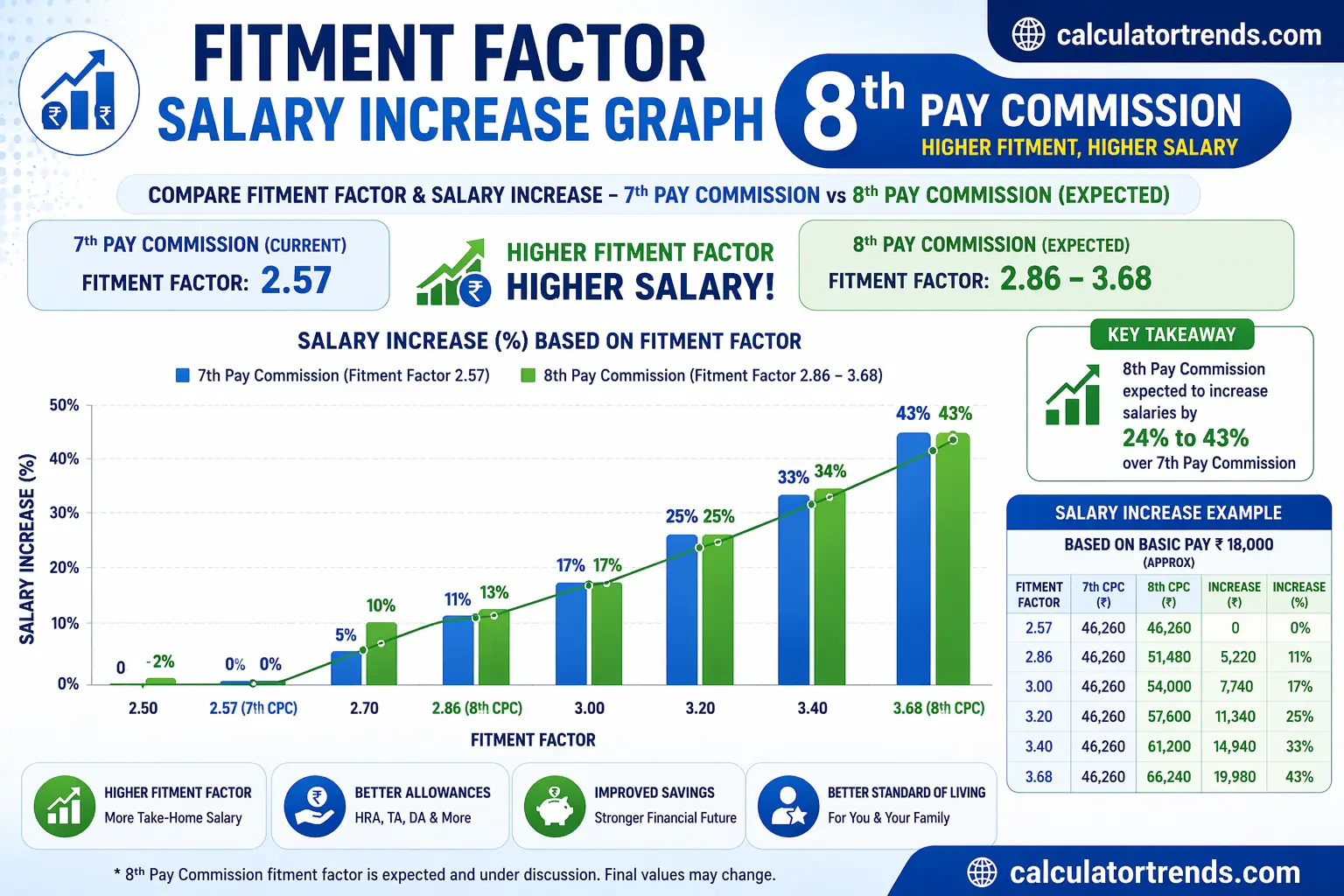
- Allowances Scale Up: Because Allowances like HRA (House Rent Allowance) and DA (Dearness Allowance) are percentages of your Basic Pay, a higher basic pay immediately inflates these allowances.
- Pensionary Benefits: Gratuity, Leave Encashment, and Commutation of Pension are calculated on the last drawn basic pay. A higher fitment factor boosts retirement corpus significantly.
State governments often adopt central guidelines with slight variations. For instance, to calculate state-specific DA and HRA impacts in Uttar Pradesh, you can calculate UP govt salary separately.
7. Why Fitment Factor Matters
Without a standardized fitment factor, integrating DA into basic pay while adding a real wage hike for over 50 lakh central government employees and 60 lakh pensioners would be mathematically chaotic.
It ensures equity across pay bands. Whether you are at Level 1 or Level 18 of the Pay Matrix, the multiplication logic ensures the percentage of real wage hike remains relatively consistent across the hierarchy.
8. Frequently Asked Questions (2026 Update)
When was the 8th Pay Commission implemented?
Maintaining the historical 10-year cycle of Central Pay Commissions, the 8th CPC modifications are officially slated to go into effect starting January 1, 2026.
What happened to the accumulated Dearness Allowance (DA)?
Upon the implementation of a new Pay Commission, the existing Dearness Allowance (which had surpassed 50%) is completely absorbed into the newly revised Basic Pay. The DA percentage officially resets to 0%.
What is the fitment factor for the 7th Pay Commission?
The approved fitment factor for the 7th Pay Commission was 2.57. It was uniformly applied to all levels to construct the revised pay matrix in 2016.