
The Ultimate Indian Banking Guide: DD vs NEFT vs IMPS vs RTGS
If you’ve ever tried to pay a college admission fee, send money to a relative, or settle a large property payment, you’ve likely been told to use a specific payment method — demand draft, NEFT, IMPS, or RTGS. Choosing the wrong one can mean delays, extra charges, or in some cases, a rejected payment.
This comprehensive guide cuts through the confusion. Here is what each financial settlement method actually does, when it makes sense, and when it is best avoided.
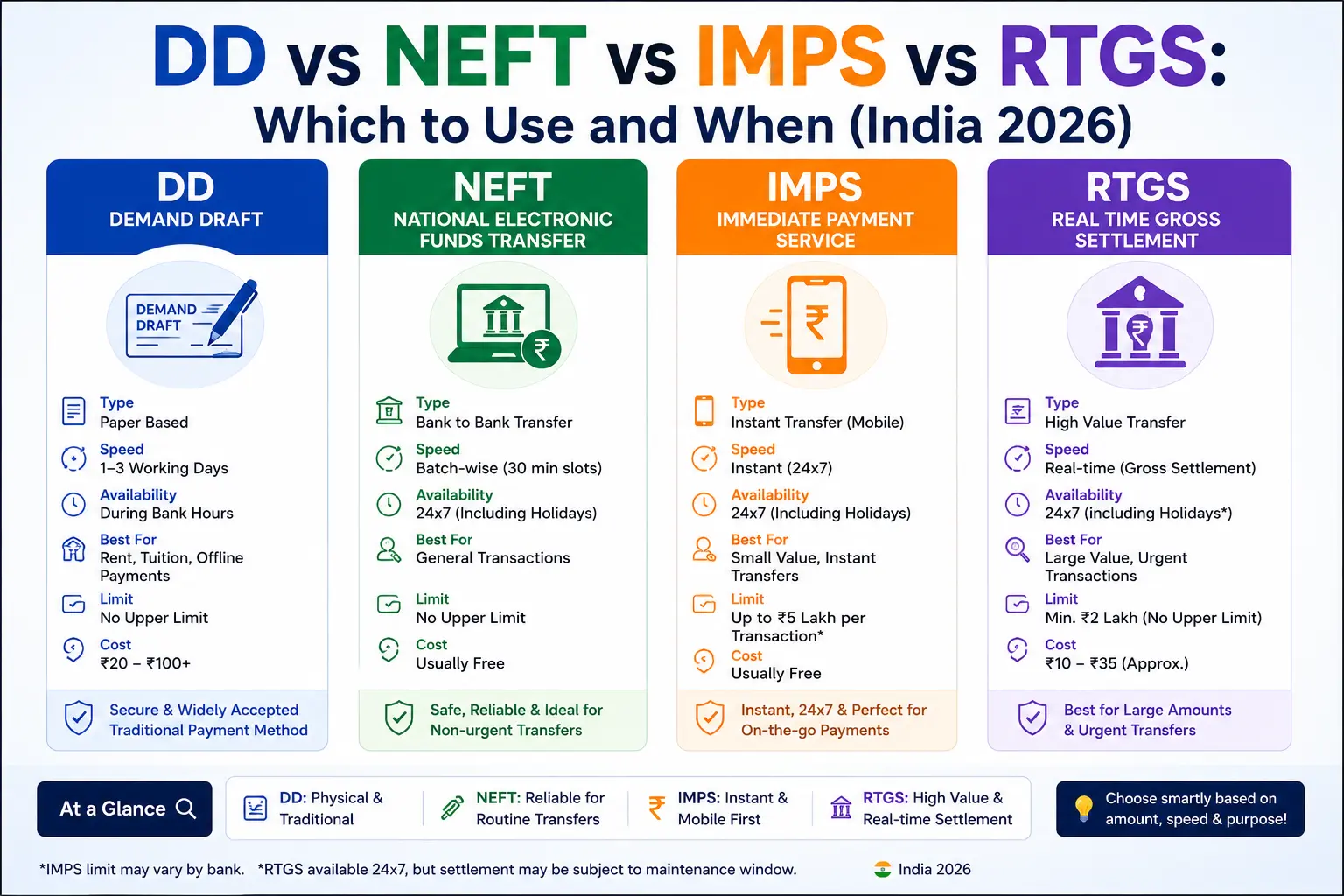
A Quick Overview Before We Go Deep
| Method | Best for | Minimum Limit | Maximum Limit | Settlement Speed |
|---|---|---|---|---|
| Demand Draft (DD) | Guaranteed payments, admissions, tenders | ₹1 | No RBI cap | 1–3 business days (physical) |
| NEFT | Routine transfers, any amount | No minimum | No RBI cap | Within 30 min (30-min batches) |
| IMPS | Instant transfers up to ₹5 lakh | ₹1 | ₹5 lakh (typical limit) | Seconds to 2 minutes |
| RTGS | High-value urgent transfers | ₹2 lakh | No RBI cap | Within 30 minutes |
Unsure which transfer protocol meets your current requirements? Input your transaction values below for an instant custom recommendation.
Demand Draft (DD): When Guaranteed Payment Matters More Than Speed
A demand draft is a physical payment instrument issued by your bank. The key difference between a DD and a personal cheque: a DD cannot bounce. When you request a DD, the bank immediately debits the amount from your account and issues a paper instrument guaranteeing that payment.
This institutional guarantee is exactly why DDs are heavily required in certain structural situations:
- College and university admissions — institutions need confirmed payment, not an unverified cheque.
- Government tenders and official applications — government departments often specify DD as the only acceptable payment mode.
- Property registrations — some state registration offices require physical DDs as part of local document verification.
- Sending money physically — if the recipient cannot receive electronic transfers.
The tradeoff: DDs are slower (the physical instrument must be deposited and cleared by the recipient’s bank), they cost money to issue, and you have to visit a branch to get one (though some banks allow online DD requests).
State Bank of India (SBI) charges a fee based on the DD amount and your account type. You can calculate the exact fee in advance using the SBI DD charges schedule.
When not to use DD: If electronic transfer is accepted, DD is almost always the less convenient and more expensive option. Use DD only when the recipient specifically requires it or when you are sending money to someone without an active bank account (by making the DD payable to them by name).
NEFT: The Workhorse for Everyday Bank Transfers
NEFT (National Electronic Funds Transfer) is the most flexible general-purpose transfer method in India. Operated by the Reserve Bank of India (RBI), there is no minimum amount — you can transfer even ₹1 via NEFT — and no system-level cap on the maximum. It processes in 30-minute batch cycles around the clock.
When NEFT makes sense:
- Paying vendors, rent, or suppliers where exact timing is not critical.
- Transferring between your own accounts at different banks.
- Routine EMI pre-payments or top-ups.
- Small to medium transfers where IMPS limits might be a concern.
Charges: NEFT charges are low — typically ₹2 to ₹25 plus GST depending on the amount. Many banks waive NEFT charges entirely for transfers initiated via net banking or mobile banking applications.
When not to use NEFT: If you need the transfer credited in the next five minutes, NEFT’s 30-minute batch cycle won’t serve you. Use IMPS or RTGS instead.
IMPS: Instant Transfers Any Time
IMPS (Immediate Payment Service) is managed and operated by the National Payments Corporation of India (NPCI) and settles transactions in real time, 24×7 — including bank holidays. Funds typically appear in the recipient’s account within seconds to two minutes.
When IMPS makes sense:
- Urgent transfers up to $\le \text{₹}5,00,000$ (₹5 Lakh).
- After-hours emergencies where a bank branch is closed.
- Peer-to-peer payments where instant confirmation matters.
- Transfers where you need immediate SMS notification confirmation.
Limits: The typical per-transaction cap on IMPS is ₹5 lakh, though individual banks may set lower limits. For transfers above ₹5 lakh, RTGS is the appropriate alternative.
Charges: IMPS charges are generally very low — ₹5 or less for most transfer amounts. Many banks offer free IMPS for small transfers.
RTGS: High-Value Transfers With Real-Time Certainty
RTGS (Real-Time Gross Settlement) is operated directly by RBI and is designed for high-value transfers. The minimum threshold is $\ge \text{₹}2,00,000$ (₹2 Lakh) — below that, RTGS is not available. Settlement happens in real time; the recipient’s account is credited within 30 minutes of your initiation.
When RTGS makes sense:
- Property or vehicle purchase payments.
- Business transactions above ₹2 lakh where you need immediate confirmed settlement.
- Large-value vendor payments where the counterparty requires RTGS.
- When the amount exceeds IMPS limits and instant settlement is needed.
For exact charges per transfer amount at SBI, refer to the SBI RTGS charges scheduler before making your transaction.
When not to use RTGS: For anything under ₹2 lakh, RTGS is simply not available. Use IMPS for instant transfer or NEFT for routine transfers below that threshold.
Side-by-Side Comparison: All Four Methods
| Factor | Demand Draft (DD) | NEFT | IMPS | RTGS |
|---|---|---|---|---|
| Operated by | Individual Bank | RBI | NPCI | RBI |
| Requires Net Banking | No (In-Branch Only) | Yes (Or at Branch) | Yes (Or Mobile App) | Yes (Or at Branch) |
| Physical Instrument | Yes (Paper Draft) | No | No | No |
| Minimum Amount | ₹1 | No limit | ₹1 | ₹2,00,000 |
| Can Bounce / Fail | No (Bank-Guaranteed) | Low risk | Low risk | Low risk |
| Settlement Timing | 1–3 days (clearing) | ~30 min (batches) | Seconds to 2 min | Real-time (under 30 min) |
| 24×7 Availability | No (Branch hours only) | Yes | Yes | Yes |
| Typical Cost | ₹50–₹2,000 + GST | ₹2–₹25 + GST | ₹5 or less | ₹20–₹55 + GST |
| Cancellable | Yes (With charges) | Very Limited | No | No |
How to Decide: A Simple Decision Flow
Follow this step-by-step logic map to select the perfect transfer route:
Key Takeaways
- Use a Demand Draft only when the recipient explicitly mandates a bank-guaranteed physical paper instrument.
- NEFT serves as the most flexible, standard, and often free mechanism for non-urgent domestic transfers of any size.
- IMPS is highly optimal when you require instant electronic confirmation for amounts up to ₹5 lakh.
- RTGS remains the gold standard for transfer values of ₹2 lakh or more where real-time clearance is required.
- For the vast majority of day-to-day transactions, IMPS and NEFT have made physical draft collection mostly obsolete.