
SBI Annuity Deposit Scheme: Payouts & Rules Explained
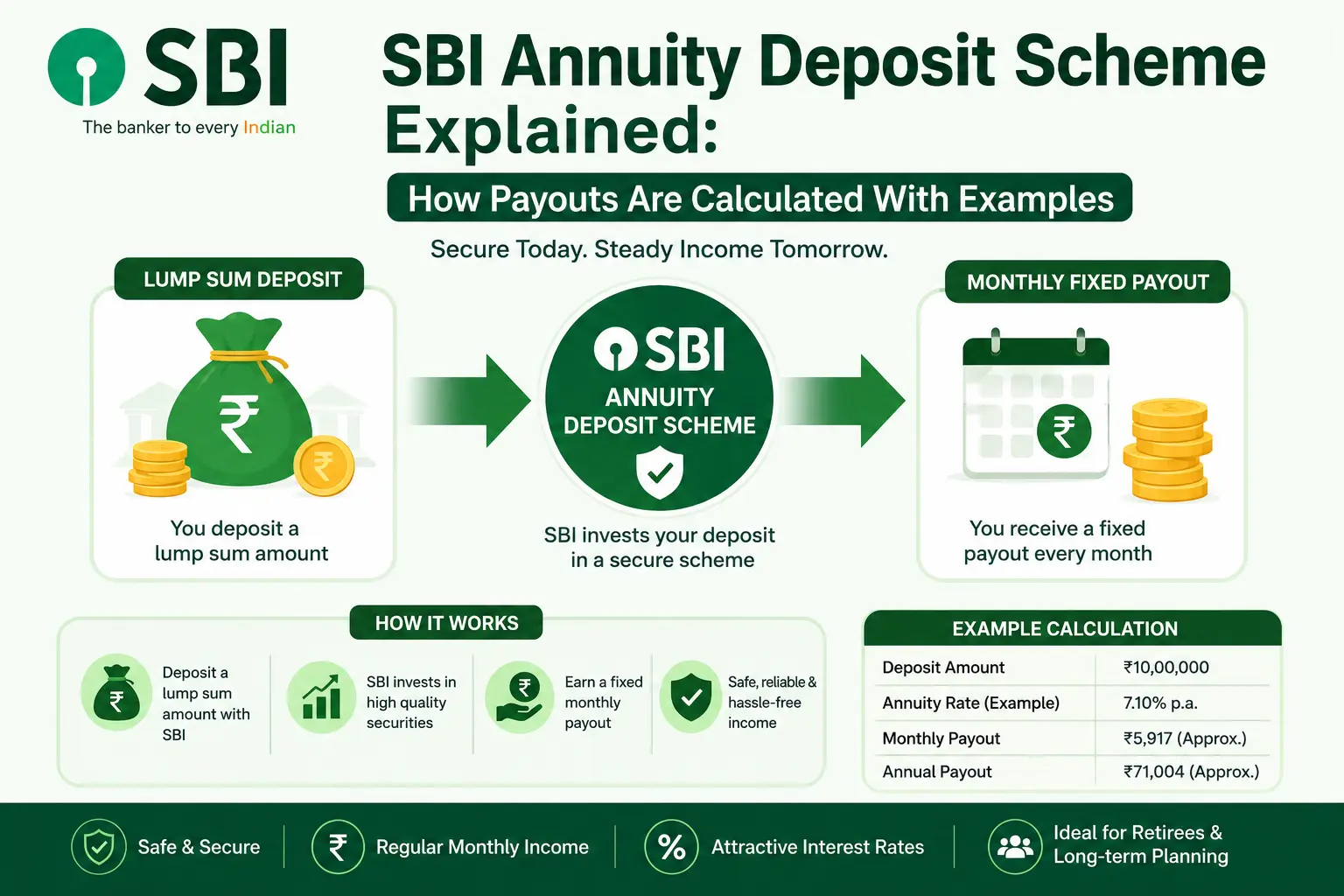
The State Bank of India (SBI) Annuity Deposit Scheme lets you deposit a lump sum and receive a fixed monthly payout for a set tenure. It is often compared to a pension-like arrangement for retirees or anyone looking for predictable monthly income from their savings.
But how does SBI actually calculate that monthly payout? Understanding the formula helps you plan before committing funds — and lets you verify whether the figure the bank gives you is accurate.
What the SBI Annuity Deposit Scheme Is
An annuity deposit is a type of fixed deposit where instead of receiving interest at maturity, you receive equal monthly instalments throughout the tenure. Each instalment contains both a principal component and an interest component — structured so that by the end of the tenure, your original deposit is fully returned (along with all interest).
Key features of this product as administered by the State Bank of India (SBI) include:
- Minimum deposit: Calculated based on a minimum monthly annuity of ₹1,000 for the chosen period (for example, approximately ₹36,000 for a 3-year term).
- Tenure options: Flexible choices of 36, 60, 84, or 120 months (equivalent to 3, 5, 7, or 10 years).
- Payout: Fixed equal monthly instalments beginning exactly one month from the date of the deposit.
- Interest rate: Standard SBI domestic term deposit rates apply based on the tenure chosen. Senior Citizens receive an additional 0.50% markup.
- Premature closure: Permitted for deposits up to ₹15 lakhs (with standard FD penalties applied). In the unfortunate event of the depositor’s demise, premature payment is permitted without any threshold restrictions.
Adjust the inputs below to calculate your estimated monthly pension/payout. Senior citizens get an added +0.50% interest boost.
| Month | Opening Balance | Payout Amount | Interest Paid | Principal Paid | Closing Balance |
|---|
The Formula Behind the Calculation
To determine the equal monthly payouts over the course of your tenure, SBI uses the standard **Present Value of an Ordinary Annuity** formula. This is the exact same compounding logic used to calculate monthly EMI loan schedules, just operationalized in reverse.
The monthly payment formula is structured as follows:
Where:
- A = Equal Monthly Payout (Annuity amount received each month)
- P = Principal (Your initial lump sum deposit amount)
- r = Monthly Interest Rate (Annual Interest Rate ÷ 12 months ÷ 100)
- n = Number of Monthly Instalments (Tenure in months, e.g., 60 months for a 5-year tenure)
Step-by-Step Example
Suppose you deposit a lump sum of **₹5,00,000** for **5 years (60 months)** at an annual interest rate of **6.50%**.
- First, convert the annual interest rate to its monthly decimal equivalent:
r = 6.50 ÷ 12 ÷ 100 = 0.00541667 - Calculate compounding factor over 60 instalments:
(1 + r)^n = (1.00541667)^60 = 1.382817 - Plug the values into our main annuity equation:
A = 5,00,000 × [ 0.00541667 × 1.382817 ] ÷ [ 1.382817 - 1 ]
A = 5,00,000 × [ 0.00748995 ] ÷ [ 0.382817 ]
A = 3,744.975 ÷ 0.382817 = ₹9,782.68(Rounded to ₹9,783)
Thus, you would receive a monthly payment of ₹9,783 for 60 consecutive months. Over the course of the tenure, your cumulative returns would equal **₹5,86,980**, yielding a total interest component of **₹86,980**.
To compute customized payout scenarios based on your chosen principal values and real-time interest margins, you can utilize our fully integrated SBI Annuity Deposit Scheme Calculator tool above.
Annuity Deposits vs. Standard Fixed Deposits
When selecting a parking vehicle for a lump-sum nest egg, it’s vital to compare the structural layouts of standard products. Below is a head-to-head comparison between standard Fixed Deposits, Recurring Deposits, and the Annuity Deposit Scheme:
| Structural Parameter | Annuity Deposit Scheme | Standard Fixed Deposit (FD) | Senior Citizen Savings Scheme (SCSS) |
|---|---|---|---|
| Inflow Pattern | One-time single Lump Sum | One-time single Lump Sum | One-time single Lump Sum |
| Outflow / Return Pattern | Equated Monthly Payouts (Principal + Interest) | Lump Sum at Maturity (or periodic interest payout only) | Quarterly Interest payouts; Principal returned at maturity | Quarterly compounding (accrued monthly) | Quarterly compounding (reinvested or paid out) | Quarterly payouts (non-compounding) |
| Principal Status | Gradually amortized to ₹0 by the end of tenure | Maintained intact and returned at final maturity | Maintained intact and returned at final maturity |
The primary benefit of the Annuity Deposit structure is the liquidation of the principal over time. This makes it highly optimal for retirees who require a stable monthly cash flow to supplement their lifestyles and do not necessarily need to leave the initial lump sum as an inheritance.
For regulatory parameters, guidelines, and updates on term deposit operations, refer to the Reserve Bank of India (RBI) official guidelines website.