
SBI RTGS – Charges, Form, Process & Complete Guide (2026)
SBI RTGS is a real-time fund transfer system offered by State Bank of India for sending ₹2 lakh or more to any bank account in India. Transfers happen instantly, work 24×7, and cost nothing when done through SBI’s online platforms. Offline branch transfers attract nominal charges starting at ₹20 plus GST.
What is SBI RTGS?
RTGS stands for Real Time Gross Settlement. Let’s break that down in plain language.
Real Time — your money leaves your account and reaches the other person’s account within minutes. No waiting, no batching.
Gross Settlement — each transaction is processed individually. The bank doesn’t club your transfer with other people’s payments.
SBI RTGS is simply this system operated through State Bank of India — either from a branch counter, the YONO app, or SBI Internet Banking.
Think of it this way. You’re buying a plot of land for ₹8 lakh. The seller wants the money today. A cheque takes days to clear. UPI has a ₹1 lakh cap on most apps. NEFT processes in batches. RTGS puts ₹8 lakh in the seller’s account in under fifteen minutes. That’s the entire point.
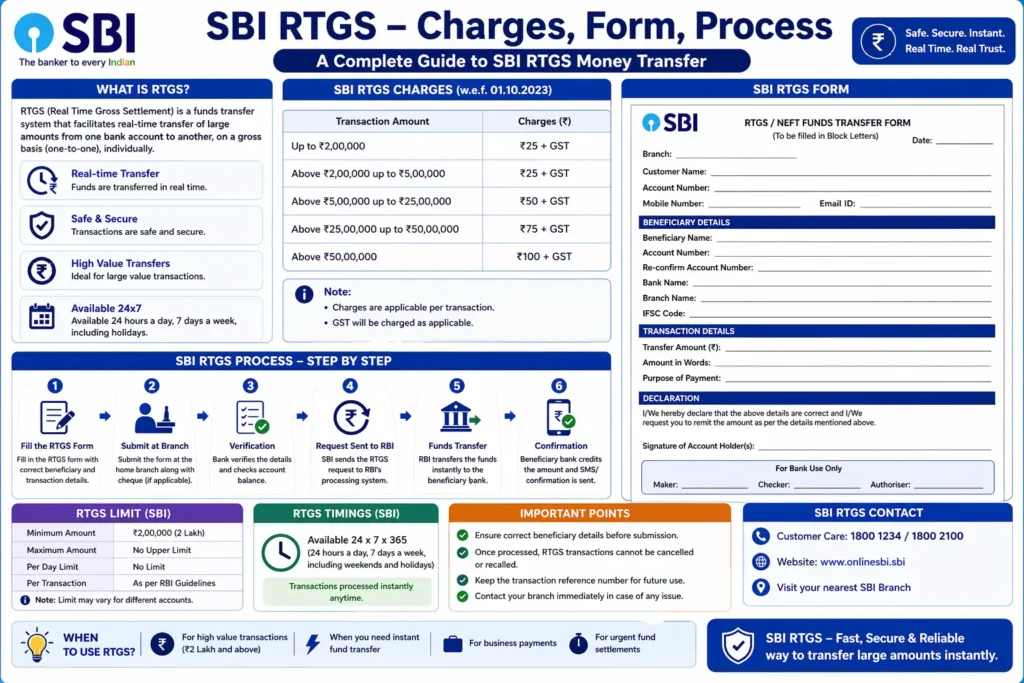
As per RBI guidelines, RTGS is meant strictly for domestic rupee transfers. It doesn’t work for international payments. And the minimum amount is always ₹2 lakh — anything below that, you’d use NEFT or IMPS instead. For a deeper breakdown of the system itself, read our guide on what is RTGS.
SBI RTGS Full Form & Meaning
| Word | Meaning |
|---|---|
| S – State | State Bank of India, the country’s largest public sector bank |
| B – Bank | — |
| I – India | — |
| R – Real | Transfer happens live, not delayed |
| T – Time | Processed the moment you hit confirm |
| G – Gross | Each payment settled on its own, not netted against others |
| S – Settlement | Final crediting of funds to the receiver’s account |
RBI introduced RTGS in India on 26 March 2004. Initially it operated only during banking hours. Since December 2020, RBI made RTGS available round the clock — all 365 days, weekends and public holidays included.
How SBI RTGS Works — The Backend Flow
Understanding the mechanics helps you troubleshoot delays. Here’s what actually happens once you press “Transfer”:
- You initiate the transfer from YONO, SBI Net Banking, or a branch counter.
- SBI debits your account immediately and validates the beneficiary’s IFSC code and account number.
- SBI sends the payment instruction to the RBI’s centralised RTGS processing system.
- RBI settles the transaction in real time — debiting SBI’s account with RBI and crediting the beneficiary’s bank account with RBI.
- The beneficiary’s bank receives the credit and posts the amount to the receiver’s account.
- You receive a UTR number (Unique Transaction Reference) — a 22-character code that serves as proof of transfer.
The entire chain typically finishes in 2 to 30 minutes. If the beneficiary’s bank takes longer, the issue is on their end, not SBI’s. Your UTR number is your receipt — save it.
One critical thing: RTGS only works with IFSC codes. Every Indian bank branch has a unique IFSC (Indian Financial System Code). You’ll find it on the beneficiary’s cheque book, passbook, or on the RBI IFSC search tool.
How to Do RTGS in SBI — Step by Step
Two routes. Online is faster, free, and available from your phone. Offline requires a branch visit and a filled form.
Online RTGS via SBI YONO App
What you need: YONO app installed, active Internet Banking credentials, beneficiary’s account number and IFSC.
Step 1 — Log in. Open YONO. Enter your username and password, or use biometric login.
Step 2 — Navigate. Tap “Payments & Transfers” from the dashboard. Select “Inter Bank Transfer” and then “RTGS”.
Step 3 — Add beneficiary (first time only). Enter the receiver’s full name exactly as it appears on their bank account, their account number, IFSC code, and optionally their mobile number or email. SBI activates new beneficiaries within 30 minutes to 4 hours — this is a one-time wait.
Step 4 — Enter amount. Minimum ₹2,00,000. Add a remark like “Property advance” or “Car payment” for your own records.
Step 5 — Confirm. Verify all details on the summary screen. Authenticate with OTP sent to your registered mobile.
Step 6 — Done. Screen shows transaction status and UTR number. Screenshot it.
Charges: ₹0. Online RTGS through SBI is completely free regardless of amount.
Online RTGS via SBI Internet Banking (Desktop)
Same process, different interface. Go to https://www.onlinesbi.sbi. Log in → Fund Transfer → Inter Bank Transfer → RTGS. Add beneficiary if not already registered. Enter amount, confirm via OTP. Free of charge.
Offline RTGS at SBI Branch
Step 1 — Visit your home branch (the branch where your account is maintained works best, though any SBI branch can process it).
Step 2 — Collect an RTGS application form from the counter, or carry a pre-filled one. You can download the RTGS form here.
Step 3 — Fill in sender details, beneficiary details, amount in figures and words, purpose of transfer.
Step 4 — Submit the form along with your passbook or account statement and a valid photo ID (Aadhaar, PAN, or passport).
Step 5 — The branch officer processes the transfer. You receive a stamped receipt with the UTR number.
Charges apply for offline transfers (see table below). Processing depends on branch workload but typically completes within 30 minutes during operating hours.
SBI RTGS Charges — Updated Table
As per SBI’s Schedule of Charges (last revised September 2024), online RTGS carries zero fees. Offline transfers attract the following charges. All offline fees are subject to 18% GST. Charges may vary slightly by account type — confirm with your branch or at sbi.co.in.
| Transfer Amount | Online (YONO / Net Banking) | Offline (Branch) | GST @ 18% on Offline | Total Offline Cost |
|---|---|---|---|---|
| ₹2,00,000 to ₹5,00,000 | Free | ₹20.00 | ₹3.60 | ₹23.60 |
| Above ₹5,00,000 | Free | ₹40.00 | ₹7.20 | ₹47.20 |
Who gets waivers:
- SBI Gold and Diamond Current Account holders — free offline RTGS
- Central and State Government departments — exempted
- Certain salary package accounts — reduced or nil charges
Inward RTGS (receiving money via RTGS into your SBI account) is always free. RBI mandates that banks cannot charge the receiver.
To estimate your exact fee before visiting the branch, use our RTGS calculator.
SBI RTGS Limit & Timing
Amount Limits
| Parameter | Limit |
|---|---|
| Minimum per transaction | ₹2,00,000 |
| Maximum per transaction | No upper cap (as per RBI) |
| Daily limit (Savings Account, online) | Typically ₹10,00,000 — varies by account tier |
| Daily limit (Current Account, online) | Higher, often ₹25,00,000+ — check YONO settings |
| Branch limit | No fixed cap; large amounts may require manager approval |
You can adjust your own daily transfer limit within YONO under “Profile” → “Set Limit”, up to the maximum your account type permits.
Timing
| Detail | Information |
|---|---|
| Availability | 24 hours x 7 days, including Sundays and bank holidays |
| Possible delay window | 11:50 PM to 12:30 AM (RBI’s brief settlement cutoff/reset) |
| Branch processing | Only during branch working hours (10 AM – 4 PM typically, varies by city) |
RBI made RTGS a 24×7 system in December 2020. Before that, it shut down at 4:30 PM on working days and didn’t operate on holidays. The current round-the-clock availability means a ₹15 lakh property token payment at 2 AM on a Sunday goes through just fine — as long as you use online banking.
SBI RTGS Form — Fields Explained
The physical RTGS form is a single-page document required only for branch transactions. Online users never need it.
You can pick one up at any SBI counter or download the RTGS form in advance and print it at home.
Field-by-Field Breakdown
| Field | What to Write | Common Mistakes |
|---|---|---|
| Sender’s Name | Your name as per SBI records | Using a nickname or short form |
| Account Number | Your SBI savings/current account number | Missing a digit — double-check from passbook |
| Branch Name & IFSC | Your SBI branch details | Writing the beneficiary’s IFSC here instead |
| Beneficiary Name | Receiver’s full name as per their bank account | Spelling mismatch causes rejection |
| Beneficiary Account No. | Their bank account number | Transposing digits — verify twice |
| Beneficiary Bank & Branch | Name and branch of receiver’s bank | Leaving it blank |
| Beneficiary IFSC | 11-character code of receiver’s bank branch | Using an old/merged branch IFSC |
| Amount in Figures | e.g., 4,50,000 | Below ₹2 lakh — RTGS won’t process |
| Amount in Words | e.g., Rupees Four Lakh Fifty Thousand Only | Mismatch with figures |
| Purpose / Remarks | e.g., “Flat booking advance” | Not mandatory but helps for records |
| Date & Signature | Current date, your signature as registered with SBI | Signature mismatch delays processing |
Pro tip: If you write the wrong IFSC, the money may bounce back to your account within 24–48 hours — but that’s 48 hours of stress you don’t need. Verify the IFSC from the beneficiary’s cheque leaf or the RBI’s IFSC directory.
SBI RTGS — Real-Life Example
Scenario: Priya, a school teacher in Lucknow, is buying a second-hand Honda City from a dealer in Delhi for ₹4,75,000. The dealer banks with ICICI Bank, Connaught Place branch.
What Priya does:
She opens SBI YONO at 9:15 PM on a Saturday night.
Goes to Payments & Transfers → Inter Bank Transfer → RTGS.
She’d already added the dealer as a beneficiary two days ago:
- Name: AutoWorld Motors Pvt Ltd
- Account: 012345678912
- IFSC: ICIC0000045
She types ₹4,75,000 in the amount field. Adds remark: “Honda City VIN #9823 full payment.”
Confirms. Enters OTP.
9:17 PM — her SBI account is debited ₹4,75,000. The UTR number appears on screen: SBIN42604150001234.
9:24 PM — the dealer’s ICICI account shows the credit. He shares a screenshot. Sends the RC transfer documents.
Total cost to Priya: ₹0. Online. No branch visit. Saturday night. Seven minutes from tap to confirmation.
If she’d gone to a branch instead, she would have paid ₹23.60 (₹20 + GST) and could only do it Monday through Friday before 4 PM.
SBI RTGS vs NEFT vs IMPS — Comparison Table
All three are RBI-regulated domestic transfer systems. The right choice depends on how much you’re sending and how urgently.
| Feature | SBI RTGS | SBI NEFT | SBI IMPS |
|---|---|---|---|
| Full Form | Real Time Gross Settlement | National Electronic Funds Transfer | Immediate Payment Service |
| Minimum Amount | ₹2,00,000 | ₹1 (no minimum) | ₹1 (no minimum) |
| Maximum Amount | No upper limit | No upper limit | ₹5,00,000 |
| Speed | Real-time (2–30 minutes) | Batch processing (settled every 30 mins, 48 batches/day) | Instant (under 30 seconds) |
| Availability | 24×7 | 24×7 | 24×7 |
| Online Charges (SBI) | Free | Free | Free up to ₹1 lakh; nominal above |
| Offline Charges (SBI) | ₹20–₹40 + GST | ₹2–₹25 + GST | Not available offline |
| Best For | High-value urgent transfers (property, vehicles, B2B) | Medium-value non-urgent transfers | Small instant peer-to-peer payments |
| Requires IFSC? | Yes | Yes | Yes (or MMID + mobile) |
| UTR Provided? | Yes | Yes | Yes |
The simple rule:
- Sending under ₹2 lakh and it’s not urgent → NEFT
- Sending under ₹5 lakh and need it instant → IMPS or UPI
- Sending ₹2 lakh or above and need it now → RTGS
Benefits of SBI RTGS
- Speed. Money reaches the receiver in minutes, not hours or days. Crucial for time-sensitive payments like property registrations where the sub-registrar is waiting.
- No upper cap. Transfer ₹2 lakh or ₹2 crore — RTGS handles both. IMPS and UPI can’t touch amounts above ₹5 lakh and ₹1–2 lakh respectively.
- Zero cost online. SBI doesn’t charge a single rupee for RTGS done through YONO or Internet Banking. For large transfers, this saves meaningful money compared to demand drafts or pay orders.
- Round-the-clock availability. Sundays, Diwali, Independence Day — doesn’t matter. The system runs 24×7 since RBI’s 2020 directive.
- Finality of payment. RTGS settlements are final and irrevocable once processed by RBI. The receiver’s bank cannot reverse it without your consent. This gives both parties legal certainty.
- Trackable. Every transaction generates a unique UTR number. If a dispute arises, this UTR is your proof — accepted by banks, courts, and tax authorities.
- RBI-regulated security. The entire chain — from SBI to RBI to the beneficiary bank — uses encrypted messaging. Fraud rates on RTGS are among the lowest of any payment method in India.
Common Mistakes to Avoid
1. Entering the wrong IFSC code. This is the single most common reason RTGS transfers fail or bounce. Always cross-verify the IFSC from the beneficiary’s physical cheque leaf or passbook — not from memory or a Google search that might show a merged/old branch code.
2. Trying to send below ₹2 lakh. The system will simply reject the transaction. For amounts under ₹2 lakh, use NEFT (batch) or IMPS (instant).
3. Not registering the beneficiary in advance (online). SBI’s beneficiary activation can take up to 4 hours. If you need to make an urgent RTGS transfer, add the beneficiary a day before. Waiting until the last minute leads to panic.
4. Mismatched beneficiary name. The name you type must match what the receiver’s bank has on file. “Rajesh Kumar” and “R. Kumar” might not match. Ask the receiver for their name exactly as it appears on their bank statement.
5. Ignoring the midnight maintenance window. Technically RTGS is 24×7, but between roughly 11:50 PM and 12:30 AM, RBI performs a brief settlement cutoff. Transfers initiated in this window may queue and process after 12:30 AM. Avoid this slot for time-critical payments.
6. Forgetting to save the UTR. The UTR number is your only proof if something goes wrong. Screenshot it, write it down, email it to yourself — whatever works. Without it, raising a dispute with either bank becomes significantly harder.
7. Using an outdated RTGS form. If you’ve downloaded a form from a random website, it might be an old version. Get the current form from sbi.co.in or directly from the branch.
Frequently Asked Questions
What is RTGS in SBI?
RTGS in SBI is a real-time electronic fund transfer system for sending ₹2 lakh or more from your State Bank of India account to any other bank account in India. Transfers settle individually and instantly through RBI’s central platform.
How much does SBI charge for RTGS?
Online RTGS through YONO or SBI Net Banking is completely free. At the branch, SBI charges ₹20 plus 18% GST (total ₹23.60) for transfers between ₹2–5 lakh, and ₹40 plus GST (total ₹47.20) for amounts above ₹5 lakh. Inward RTGS (receiving) is always free.
What is the minimum and maximum amount for SBI RTGS?
Minimum is ₹2,00,000 per transaction. There is no maximum limit as per RBI rules. Your individual daily cap depends on your account type and can be checked or modified in the YONO app under profile settings.
What are SBI RTGS timings?
SBI RTGS operates 24 hours a day, 7 days a week, including weekends and public holidays. A brief processing pause may occur between 11:50 PM and 12:30 AM during RBI’s end-of-day settlement. Branch-initiated RTGS is available only during branch working hours.
Do I need a form for SBI RTGS?
Only if you’re transferring through a branch. Online transfers via YONO or SBI Internet Banking don’t require any physical form. For branch visits, collect the form at the counter or download it beforehand.
How long does SBI RTGS take?
Typically 2 to 30 minutes. The transfer from SBI’s end is near-instant. The beneficiary’s bank may take a few additional minutes to post the credit. If it hasn’t arrived within 2 hours, contact SBI customer care with your UTR number.
Is SBI RTGS safe?
Extremely. RTGS operates on RBI’s secure infrastructure with end-to-end encryption. Each transaction is uniquely tracked via a UTR number. Fraud incidence on RTGS is statistically negligible compared to card-based or UPI transactions, largely because it requires full beneficiary verification and OTP authentication.
Can I do SBI RTGS on Sunday?
Yes. Since December 2020, RBI has made RTGS a 24×7 system. You can transfer any amount above ₹2 lakh on Sundays, national holidays, or at 3 AM — as long as you use online banking. Branch counters remain closed on Sundays and gazetted holidays.
Conclusion
SBI RTGS remains the fastest and most reliable method for transferring ₹2 lakh or more within India. Online transfers are free, settle in minutes, and work at any hour of any day. For branch users, charges stay minimal — under ₹50 even for the highest slab. The key is getting the IFSC and beneficiary details right the first time.
Save your UTR number after every transaction. Register beneficiaries ahead of time to avoid last-minute delays. And for anything under ₹2 lakh, switch to NEFT or IMPS instead.
Estimate your transfer costs with our RTGS calculator, or check the latest official schedule at sbi.co.in. For RBI’s master circular on RTGS, visit rbi.org.in.
Disclaimer: All charges, limits, and timings referenced in this guide are based on publicly available SBI and RBI information as of early 2026. Banks periodically revise their fee schedules. Always confirm current charges with your branch or SBI’s official website before initiating a transfer.