
Tamil Nadu SSLC Grading System Explained
Every year, hundreds of thousands of students in Tamil Nadu receive their SSLC (Class 10) results — and many are left wondering what their grades actually mean in terms of percentage, whether they qualify for their preferred stream, and how to convert a letter grade for a college application.
The Tamil Nadu grading system is straightforward once you understand its structure. This guide explains everything: how letter grades are assigned, how to calculate your percentage from grades, and what the grades mean practically for your next academic step.
What Is the SSLC Exam in Tamil Nadu?
SSLC stands for Secondary School Leaving Certificate. It is the Class 10 board examination conducted by the Tamil Nadu Directorate of Government Examinations (TNDGE). Students write exams in six subjects: Tamil (or other first language), English, Mathematics, Science, Social Science, and an optional/elective subject.
The maximum marks per subject is 100, and the total maximum marks is 600.
Interactive SSLC Calculator & Converter
Select a tab below to instantly compute percentages from exact marks or estimate them based on letter grades.
No marksheet? No problem. Pick your expected letter grade for each subject to compute an estimated total percentage.
How Tamil Nadu Grades Work: The Letter Grade Scale
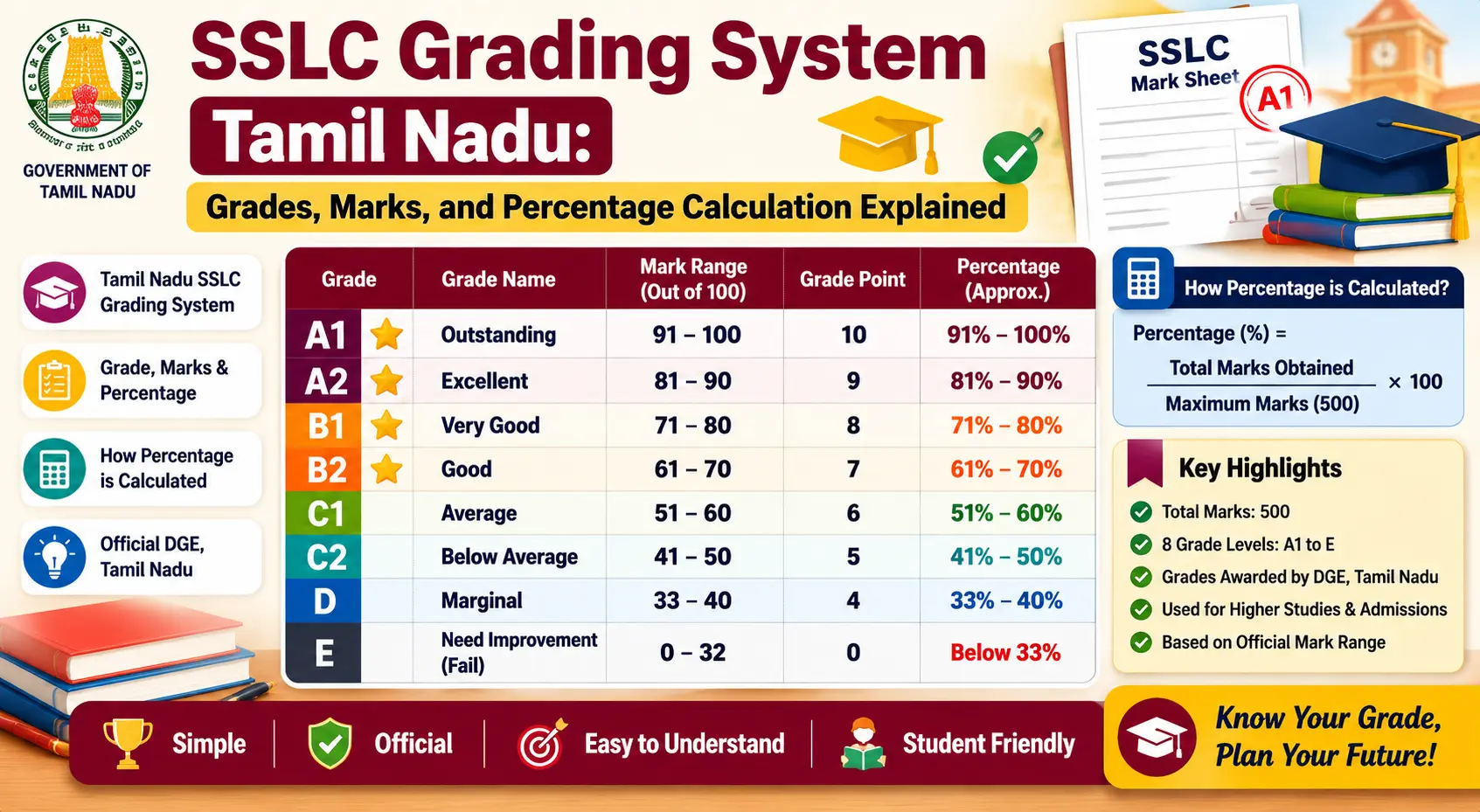
Tamil Nadu SSLC uses a letter grade system where grades are assigned based on the marks scored in each subject. The grading scale is:
| Grade | Mark Range | Description |
|---|---|---|
| A1 | 91–100 | Outstanding |
| A2 | 81–90 | Excellent |
| B1 | 71–80 | Very Good |
| B2 | 61–70 | Good |
| C1 | 51–60 | Average |
| C2 | 41–50 | Satisfactory |
| D | 35–40 | Qualifying Grade |
| E | Below 35 | Fail |
An A1 is the highest possible grade in a subject. A D is the minimum passing grade. Any subject with an E grade means you have not passed that subject.
How to Calculate Your SSLC Percentage
Your overall percentage is calculated from the total marks you scored across all six subjects, divided by 600, multiplied by 100.
Percentage = (Total marks scored ÷ 600) × 100
Example:
If a student scores Tamil: 78, English: 82, Maths: 91, Science: 88, Social Science: 75, Optional: 80 — the total is 494 out of 600.
Percentage = (494 ÷ 600) × 100 = 82.33%
You can use our dedicated SSLC percentage calculator to do this instantly — enter your subject-wise marks and get the percentage in seconds.
Converting Letter Grades to Percentage
Sometimes an institution asks for a percentage, but your marksheet shows only letter grades (not the exact marks). In that case, you can use the midpoint of each grade’s range as an approximation.
For example, if you received A2 in Maths, the range is 81–90, and the representative value used is typically 85.5 (midpoint).
The SSLC grade to percentage converter handles this calculation automatically — select your grades per subject and it generates an estimated percentage based on the official grade ranges.
What the Grades Mean for Admissions
Tamil Nadu colleges and institutions typically refer to the percentage (or total marks) for admission cutoffs, not the letter grade directly. Here is a general mapping of what the grades correspond to in percentage terms and how they translate to competitive admissions:
| Grade range (all subjects) | Approximate percentage | Competitive standing |
|---|---|---|
| All A1 | Above 91% | Top tier for science and commerce streams |
| Mix of A1 and A2 | 81–90% | Strong for most streams including science |
| B1 range | 71–80% | Eligible for most streams; competitive for arts |
| B2 range | 61–70% | Eligible for most streams with subject conditions |
| C and D range | Below 60% | Eligible for general streams; limited competitive programs |
For professional courses, nursing, and engineering diploma programs, the cutoff is often based on specific subjects (Maths and Science for technical streams) rather than overall percentage.
Understanding the Distinction and First Class Thresholds
While Tamil Nadu SSLC uses the grade scale above, many students ask about “first class” and “distinction” — terms more commonly used in degree-level examinations. For Class 10 purposes:
- TNDGE does not formally use “first class / distinction” terminology on the SSLC certificate itself.
- Colleges and institutions may interpret 75% and above as First Class equivalent, and 85% and above as Distinction equivalent for internal classification.
- The actual certificate shows grades per subject and total marks — the percentage and classification are derived from those.
How Departmental Passes and Supplementary Exams Work
If you receive an E grade in one or more subjects, you are eligible for the supplementary (compartment) examination conducted by TNDGE a few months after the main results. A pass in the supplementary exam grants you the SSLC certificate with a note indicating supplementary pass.
Students with multiple E grades may need to re-appear as a full repeater in the next year’s examination.
Key Takeaways
- Tamil Nadu SSLC uses a letter grade scale from A1 (91–100) to E (below 35).
- Percentage is calculated as total marks scored divided by 600, multiplied by 100.
- The minimum passing grade per subject is D (35 marks).
- Letter grades can be converted to an estimated percentage using grade midpoints — use our SSLC grade to percentage converter for a quick estimate.
- For exact marks and official percentage, refer to the TNDGE results portal.
Frequently Asked Questions
What is the minimum marks to pass SSLC in Tamil Nadu?
The minimum passing mark per subject is 35 out of 100, which corresponds to a D grade. You must pass all six subjects (score at least D) to receive the SSLC certificate.
Can I check my SSLC percentage online?
Yes. The TNDGE publishes results on its official website (tnresults.nic.in) where you can view your marks per subject and calculate your percentage. The SSLC percentage calculator on this site can compute the percentage instantly once you have your marks.
Is SSLC equivalent to Class 10 from CBSE?
Yes. SSLC from Tamil Nadu (TNDGE) is equivalent to Class 10 under CBSE or ICSE. Most institutions across India recognize it as the standard Class 10 qualification.
What does “A+” mean in SSLC?
Tamil Nadu SSLC uses A1 and A2 as the top two grades — there is no “A+” in the formal TNDGE scale. If you see “A+” on a result or document, it typically refers to a score above 91 (equivalent to A1 in TNDGE terminology).
How is the grading system different in Kerala SSLC?
Kerala uses a different grade scale and credit system under its Board of Public Examinations. The maximum total differs, and the grading bands are not identical to Tamil Nadu. If you are calculating for Kerala SSLC, use the Kerala-specific tool on our SSLC grade to percentage converter page.