
Understanding Grading Systems in India: Percentage, CGPA, GPA
Whether you are a student, a parent, or applying for a job, one confusion almost everyone faces is: what is a percentage, what is a grade, and what exactly does CGPA mean?
Understanding grading systems in India can feel like cracking a code, especially when every board and university follows its own unique system. Marks out of 100 are converted into grades, grades become your CGPA, and then during placements or admissions, everything must be converted back into a percentage. It can be quite dizzying, right?
Relax. This article breaks down the entire grading system in India—from school boards to universities—with official tables, formulas, and real examples. Whether you are decoding your CBSE result or comparing your college CGPA for a master's abroad, this guide covers it all.
- Marks → Grade → CGPA: Students earn marks out of 100 per subject. Those marks fall into grade bands (A1, B2, etc.), and the average of grade points across subjects becomes your CGPA.
- Multiple systems co-exist: CBSE and ICSE use a 10-point scale. Many universities use a 4.0 GPA scale. State boards often stick to raw percentages.
- Conversion is almost always required: Jobs, competitive exams, and foreign universities ask for a percentage—so you will need formulas like
CGPA × 9.5to translate between systems. - Classification labels matter: Terms like "First Class," "Distinction," and "Second Class" carry weight on marksheets and resumes, each tied to specific percentage slabs.
- No single national standard exists: The UGC provides guidelines, but individual institutions tweak cutoffs, grade bands, and weightages to fit their own evaluation philosophy.
Quick CGPA to Percentage Converter
Types of Grading Systems in India
India doesn't run on one grading system. Depending on whether you are in school or college, or which board you fall under, you will encounter one of three primary methods of evaluation. Let's explore how they function.
A. Percentage System (Marks out of 100)
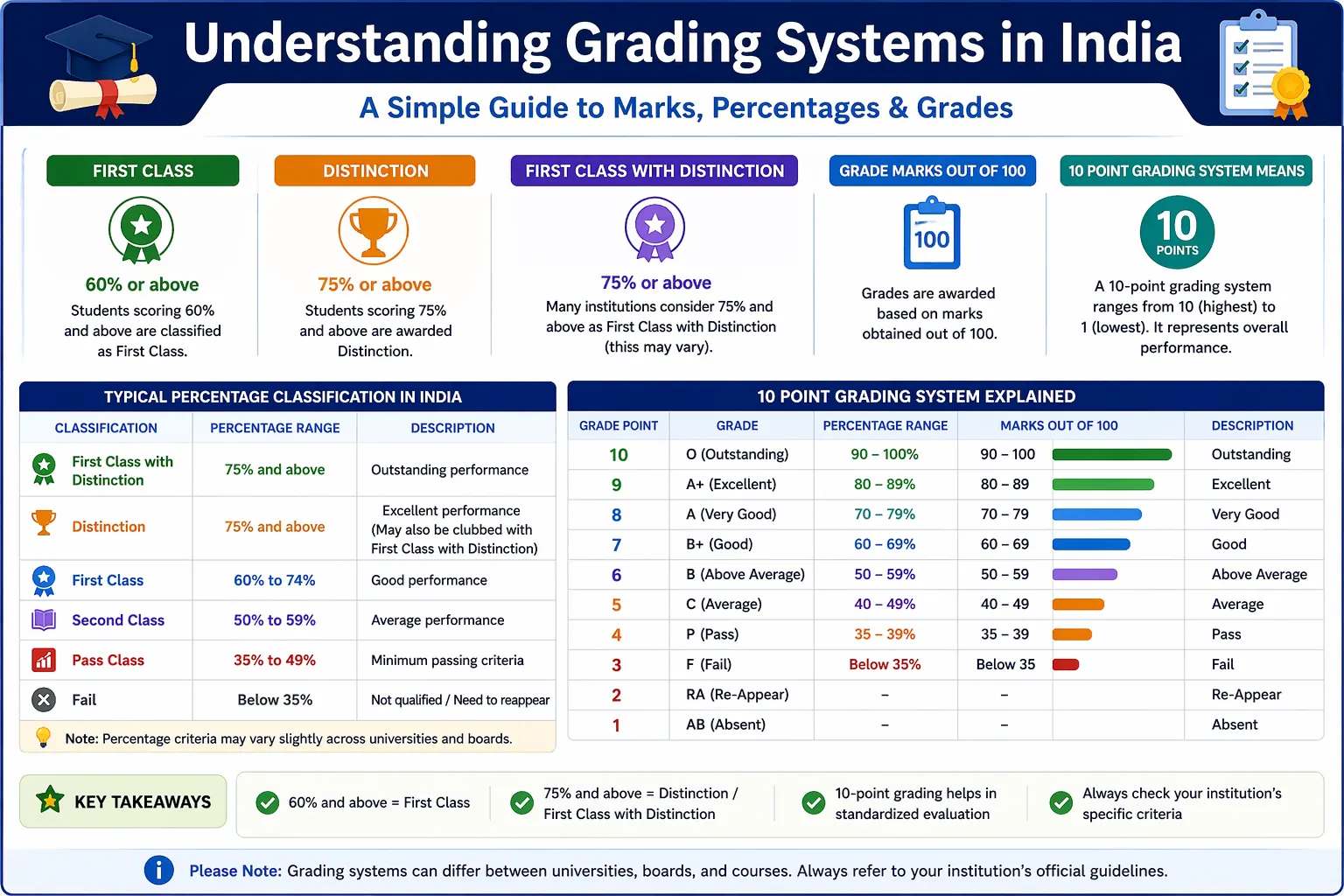
This is the traditional and most widely understood system. It simply represents your grade marks out of 100. If you score 425 out of 500 total marks, your percentage is calculated as (425/500) × 100 = 85%. Many state boards (like UP Board and Maharashtra Board) still rely heavily on direct percentage scoring rather than assigning alphabetical grades.
While it is highly transparent, the downside is that a single mark difference can change your class or rank, which creates enormous pressure over tiny margins.
B. CGPA / 10-Point Scale System
So, what exactly does a scale 10 grading system means? It assigns each subject a grade point between 1 and 10 based on the marks band your score falls into. Your CGPA (Cumulative Grade Point Average) is the arithmetic mean of all these grade points across your subjects.
CBSE Grade Bands (Class 9–12):
| Marks Range | Grade | Grade Point |
|---|---|---|
| 91–100 | A1 | 10 |
| 81–90 | A2 | 9 |
| 71–80 | B1 | 8 |
| 61–70 | B2 | 7 |
| 51–60 | C1 | 6 |
| 41–50 | C2 | 5 |
| 33–40 | D | 4 |
| Below 33 | E (Fail) | — |
Conversion formula: Percentage = CGPA × 9.5
This formula is officially provided by CBSE. Example: A CGPA of 8.4 means approximately 8.4 × 9.5 = 79.8%. The multiplier 9.5 is an empirical approximation—it aligns CGPA-based results roughly with traditional percentage outcomes across large student populations.
C. 4.0 Scale System (GPA)
What is scale 4 grading system? It's a Grade Point Average calculated on a maximum of 4.0, where each letter grade carries a fixed point value. Widely used in IITs, IIMs, NITs, many private universities, and virtually all institutions aligned with American academic standards.
Official University Credit-Based Grading System (CBCS Example)
While the CBSE system is common in schools, higher education in India (Undergraduate and Postgraduate programs) operates under the UGC's Choice Based Credit System (CBCS). Under this system, grades are not just based on marks, but are also weighted by the "Credits" assigned to each specific course.
Below is the official 10-point grading matrix used by standard Indian universities for UG and PG programs:
| Range of Marks | Grade Point | Letter Grade | Description |
|---|---|---|---|
| 90 - 100 | 9.0 - 10.0 | O | Outstanding |
| 80 - 89 | 8.0 - 8.9 | D+ | Excellent |
| 75 - 79 | 7.5 - 7.9 | D | Distinction |
| 70 - 74 | 7.0 - 7.4 | A+ | Very Good |
| 60 - 69 | 6.0 - 6.9 | A | Good |
| 50 - 59 | 5.0 - 5.9 | B | Average |
| 40 - 49 | 4.0 - 4.9 | C | Satisfactory (UG Only) |
| 00 - 39 | 0.0 | U | Re-appear (Fail) |
| ABSENT | 0.0 | AA | Absent |
How is University GPA Calculated?
In a university setting, simply averaging your grades isn't enough. You must calculate the weighted average based on the course credits. The official formula used for a semester is:
Your overall CGPA is simply this same formula applied across all courses in your entire degree program.
The Classification System: Distinction & First Class
In the university grading system across India, degrees aren't just awarded; they are "classified" into tiers based on your final CGPA. Whether you are applying for a government job, a master's degree, or sitting for campus placements, crossing specific CGPA thresholds is critical.
Here is the official classification standard for successful candidates:
| CGPA Range | Grade | Classification of Final Result |
|---|---|---|
| 9.5 - 10.0 | O+ | First Class - Exemplary* |
| 9.0 - 9.49 8.5 - 8.99 8.0 - 8.49 7.5 - 7.99 | O D++ D+ D | First Class with Distinction* |
| 7.0 - 7.49 6.5 - 6.99 6.0 - 6.49 | A++ A+ A | First Class |
| 5.5 - 5.99 5.0 - 5.49 | B+ B | Second Class |
| 4.5 - 4.99 4.0 - 4.49 | C+ C | Third Class (UG Only) |
| 0.0 - 3.99 | U | Re-appear |
*Note: To achieve "First Class - Exemplary" or "First Class with Distinction", a candidate typically must pass all subject examinations in their first appearance within the prescribed duration of the program. Additionally, for PG programs, the "Third Class" category usually does not exist, as a CGPA below 5.0 results in a "Re-appear" (Fail).
The first class percentage in India strictly starts at 60% (or a CGPA of 6.0). The distinction percentage requires a minimum of 75% (or a CGPA of 7.5). Falling even slightly short drops you into the standard first-class bracket.
Grade to Marks Conversion Examples
Let's look at real-world examples to understand how grade marks out of 100 translate across different systems in the real world.
Scenario 1: School Student — Marks to Grade (CBSE Class 10)
Priya scores the following in her five main subjects: Hindi 87, English 92, Math 78, Science 81, Social Science 74. Total: 412 out of 500. Percentage: 82.4%.
Grade points per subject: Hindi = 9 (A2), English = 10 (A1), Math = 8 (B1), Science = 9 (A2), Social Science = 8 (B1). CGPA = (9 + 10 + 8 + 9 + 8) ÷ 5 = 8.8. Cross-check: 8.8 × 9.5 = 83.6% — close to her actual 82.4%, with the small gap reflecting the approximation built into the 9.5 multiplier.
Scenario 2: Engineering Student — Semester GPA (CBCS Scale)
Arjun completes a semester with four courses: Data Structures (4 credits, Grade O/10), Circuit Theory (4 credits, Grade D+/8), Mathematics III (3 credits, Grade A+/7), Workshop (2 credits, Grade A/6).
Total credit-weighted points: (4×10) + (4×8) + (3×7) + (2×6) = 40 + 32 + 21 + 12 = 105.
Total credits: 13. Semester GPA = 105 ÷ 13 = 8.07. He lands securely in the "First Class with Distinction" bracket.
FAQ: Common Questions on Grading Systems in India
What is first class percentage in India?
What is distinction percentage in India?
What does scale 10 grading system mean?
How to convert CGPA to percentage?
What is 4 scale grading system?
Is CGPA 8.5 considered good?
Wrapping Up
India's grading landscape is fragmented—percentage here, CGPA there, GPA somewhere else—and every board defines its own bands independently. But the core logic stays consistent: marks convert to grades, grades average into cumulative scores, and classification labels (First Class, Distinction) follow from percentage slabs. Keep your institution's specific conversion formula handy, utilize percentage and CGPA calculators for quick checks, and always verify against your official transcript before submitting applications.