
Indian Education Grading Systems Explained
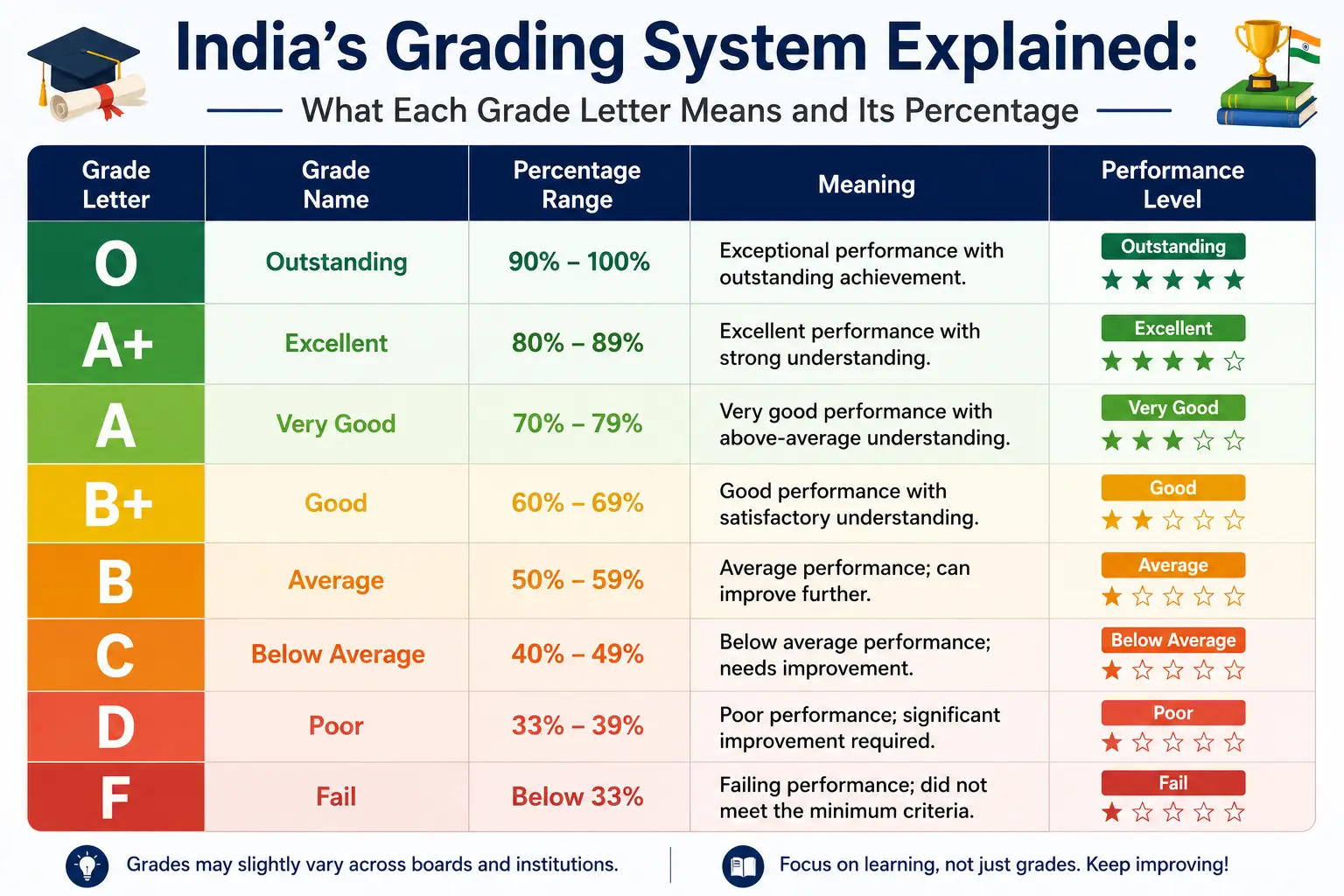
If you’ve received a result sheet showing an “O” grade or an “A+” and wondered what percentage that represents — you’re not alone. India uses multiple grading systems across different boards and universities, and the terminology can be genuinely confusing.
This guide covers the most common grading systems used across Indian schools, state boards, and universities — with the percentage ranges each grade corresponds to, and how to convert between them.
Why India Has Multiple Grading Systems
India’s education system is decentralised. The CBSE follows one grading scale, the UGC has issued guidelines for universities on a different scale, and state boards like Tamil Nadu’s TNDGE or Kerala’s DHSE use their own systems. Even individual universities sometimes define their own grade boundaries.
The result: a student from Tamil Nadu applying to a Delhi university, or to a foreign institution, often needs to translate their letter grade into a percentage — and the translation depends entirely on which board or institution issued the grade.
Interactive CGPA & Grade Explorer Widget
Convert your Cumulative Grade Point Average (CGPA) to an estimated percentage, or explore grade criteria dynamically.
The UGC 10-Point Grading Scale (Most Indian Universities)
The University Grants Commission (UGC) issued guidelines recommending a standard 10-point grading scale for undergraduate and postgraduate programmes. Most central universities and many state universities follow this:
| Grade | Grade Point | Percentage Range | Description |
|---|---|---|---|
| O (Outstanding) | 10 | 85–100% | Highest possible grade |
| A+ (Excellent) | 9 | 75–84% | Superb academic standing |
| A (Very Good) | 8 | 65–74% | Very high credit performance |
| B+ (Good) | 7 | 55–64% | Above standard benchmark |
| B (Above Average) | 6 | 50–54% | Satisfactory credit standing |
| C (Average) | 5 | 40–49% | Medium baseline performance |
| P (Pass) | 4 | 35–39% | Minimum passing grade |
| F (Fail) | 0 | Below 35% | Did not meet baseline limits |
| Ab (Absent) | 0 | — | No evaluation attempt |
Important note: The UGC scale is a recommendation, not a mandate. Individual universities may shift the percentage boundaries slightly. For example, some universities define O as 90–100% rather than 85–100%. Always refer to your specific university’s ordinance or examination regulations for the exact scale.
The CBSE Grading System (Class 9 and 10)
The Central Board of Secondary Education (CBSE) uses a different letter-grade system for continuous and comprehensive evaluation in Classes 9 and 10:
| Grade | Mark Range | Grade Point |
|---|---|---|
| A1 | 91–100 | 10 |
| A2 | 81–90 | 9 |
| B1 | 71–80 | 8 |
| B2 | 61–70 | 7 |
| C1 | 51–60 | 6 |
| C2 | 41–50 | 5 |
| D | 33–40 | 4 |
| E1 | 21–32 | — (fail) |
| E2 | 0–20 | — (fail) |
For CBSE Class 12, the board reverted to reporting marks out of 100 per subject (not letter grades) on the final marksheet, though internal assessments may still use grades.
Tamil Nadu SSLC Grading System
Tamil Nadu uses the TNDGE grading scale for Class 10 (SSLC) results:
| Grade | Mark Range |
|---|---|
| A1 | 91–100 |
| A2 | 81–90 |
| B1 | 71–80 |
| B2 | 61–70 |
| C1 | 51–60 |
| C2 | 41–50 |
| D | 35–40 (minimum pass) |
| E | Below 35 (fail) |
Use the SSLC percentage calculator to convert Tamil Nadu SSLC marks to percentage, and the grading system reference for a full breakdown.
What “First Class,” “Second Class,” and “Distinction” Mean
These terms are older classification labels, more common at degree level than school level. They are not grade letters — they are outcome classifications:
| Classification | Typical percentage range |
|---|---|
| Distinction | 75% and above (some institutions: 70%+) |
| First Class | 60–74% |
| Second Class | 50–59% |
| Third Class / Pass Class | 40–49% (or 35–49% depending on institution) |
| Fail | Below the pass mark |
These boundaries vary by institution. An institution might define Distinction as 70%, another as 75%, another as 80%. Your institution’s examination regulations are the definitive source.
CGPA to Percentage Conversion
If your result shows a CGPA (Cumulative Grade Point Average) on a 10-point scale and you need to convert it to percentage, use this approximate formula recommended by CBSE:
Percentage = CGPA × 9.5
Example: A CGPA of 8.6 corresponds to approximately 8.6 × 9.5 = 81.7%
For UGC-scale CGPAs at university level, the conversion factor is generally different and set by the university. Consult your institution’s academic handbook or ask the examination office for the official formula.
How to Handle Grade Conversion for Applications
If you are applying to a foreign university or scholarship programme that asks for your percentage and your result shows only letter grades:
- Check whether your institution’s official website provides a grade-to-percentage conversion table.
- If not, request a conversion certificate from your university’s examination controller — many institutions issue these officially.
- For SSLC grades specifically, the TNDGE or Kerala board publishes the official grade-mark range that can be cited in applications.
- Avoid self-calculated conversions without citing the source, as foreign institutions may ask for verification.
Key Takeaways
- India uses multiple grading systems — UGC, CBSE, and state boards all have different scales.
- The UGC 10-point scale uses O (Outstanding) as the top grade, equivalent to 85–100% at most universities.
- “First Class,” “Second Class,” and “Distinction” are outcome classifications — not letter grades — and their percentage thresholds vary by institution.
- CGPA on CBSE’s scale can be approximated to percentage using the formula: CGPA × 9.5.
- Always verify percentage boundaries from your specific institution’s official examination ordinance, not general tables.