
Understanding Real-Time Gross Settlement (RTGS)
Real-time Gross Settlement — or RTGS — is one of the most reliable ways to transfer large sums of money between bank accounts in India. If you’ve ever needed to move ₹2 lakh or more quickly and with certainty, RTGS is likely what your bank used.
But most people only encounter RTGS when they’re standing at a bank counter filling out a form. Understanding what actually happens during that transfer — and why it costs what it does — helps you use it more confidently.
Not sure which transfer type to use? Enter your transaction details below to find the best channel and estimate charges.
What RTGS Actually Means
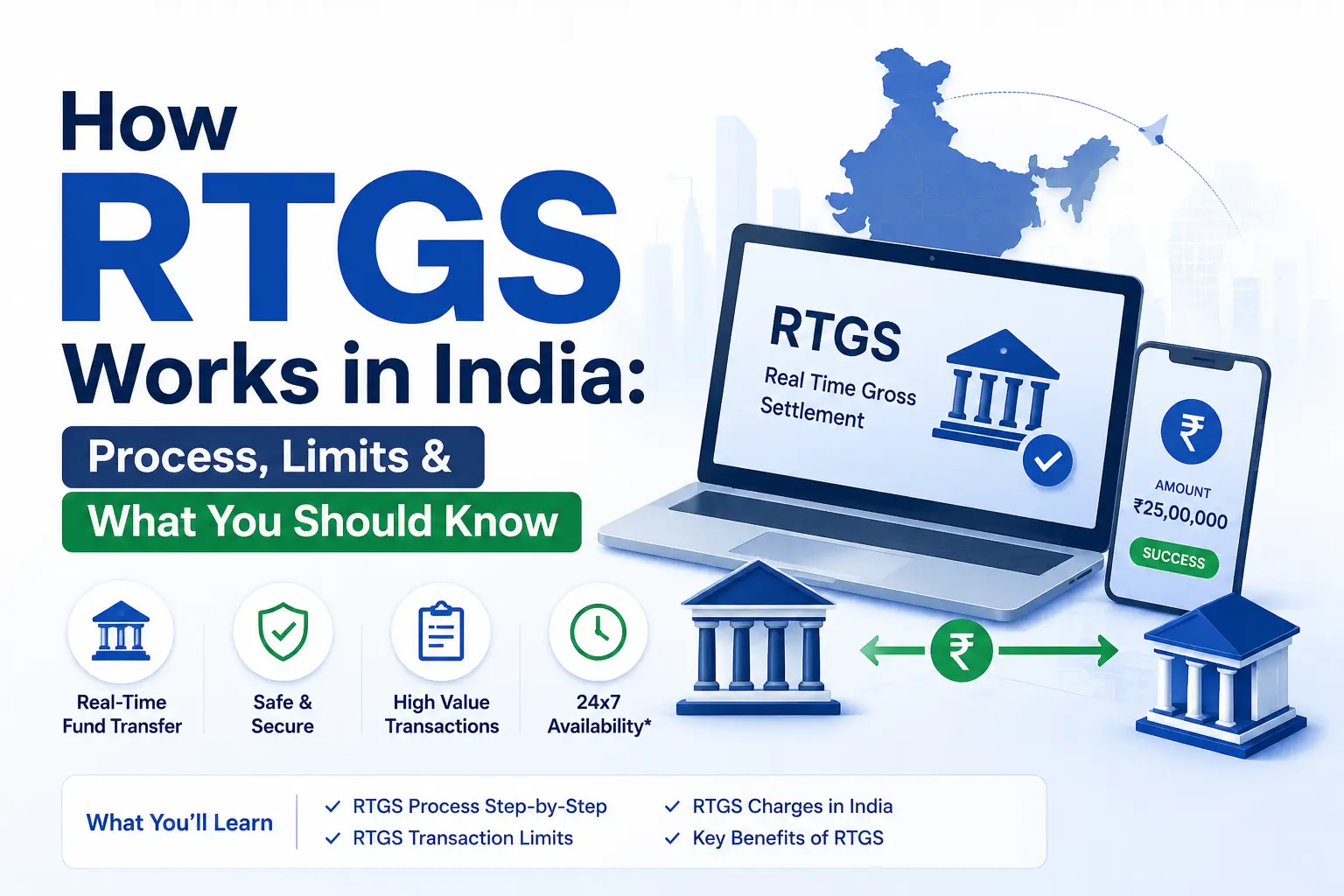
RTGS stands for Real-Time Gross Settlement. Break that down and you get the full picture:
- Real-time means the transaction is processed immediately, not batched with others at the end of the day.
- Gross settlement means each transaction is settled individually, on its own merits, rather than being netted against other transfers.
Together, this means when you initiate an RTGS transfer, the funds leave your account and arrive in the recipient’s account within minutes — not hours or the next day.
Who Operates RTGS in India?
RTGS in India is operated and maintained by the Reserve Bank of India (RBI). It runs on RBI’s infrastructure, which means it carries the institutional reliability of the country’s central banking system. Every participating bank — including SBI, HDFC, ICICI, PNB, and hundreds of others — connects to this central RBI infrastructure to process transfers.
When Is RTGS Available?
As of December 2020, RTGS in India is available 24 hours a day, 7 days a week, including bank holidays and Sundays. The RBI extended RTGS to round-the-clock operations to support continuous, high-volume settlement needs.
Before December 2020, RTGS operated only on working days between 7:00 AM and 6:00 PM. The shift to 24×7 was a significant upgrade for businesses and individuals who needed after-hours or weekend transfers.
Minimum and Maximum Transfer Amounts
This is the most important practical detail for most users:
| Limit type | Amount Guidelines |
|---|---|
| Minimum Transfer | ₹2,00,000 (₹2 Lakh) |
| Maximum Transfer | No upper cap set by RBI (Banks may set internal daily limits) |
RTGS has a strict minimum transaction threshold of ₹2 lakh. If you need to transfer less than ₹2 lakh, RTGS will not be available. NEFT or IMPS are the appropriate alternatives for those transactions.
How Does an RTGS Transfer Actually Work?
Click on any of the steps below to track the standard flow of funds from inception to destination:
Through your bank’s net banking portal, mobile app, or by submitting a physical RTGS form at a branch. You provide the recipient’s name, account number, IFSC code, and the transfer amount.
Your bank’s central core banking system packages your transfer instruction securely and forwards it directly to the RBI’s RTGS central computer system in real time.
RBI verifies that your bank has sufficient funds in its clearing settlement account to cover the transfer. Each bank maintains a current account with RBI for this exact purpose.
RBI debits your bank’s settlement account and credits the recipient bank’s settlement account simultaneously. This happens in real time — the transaction is now final and irrevocable.
The recipient bank receives instant confirmation from the RBI and is mandated to credit the beneficiary’s account within 30 minutes of receiving the transfer notification.
RTGS Charges: What Banks Typically Charge
Since RTGS itself is operated by RBI, the RBI does not charge individual customers. However, your bank charges a service fee for facilitating the transfer on your behalf.
Charges vary by bank and by transfer amount. For example, SBI applies a tiered slab structure based on the amount transferred. You can check the details using the SBI RTGS charges schedule before initiating a transfer.
As a general benchmark across major Indian banks:
- Transfers between ₹2 lakh and ₹5 lakh typically attract charges in the range of ₹20–₹30 (excluding GST)
- Transfers above ₹5 lakh may attract charges of ₹40–₹55 (excluding GST)
Always confirm the current charge with your bank before initiating, as service charge structures are revised periodically.
RTGS vs NEFT vs IMPS: Which Should You Use?
To help you compare methods, look at this structured overview of India’s main payment rails:
| Feature | RTGS | NEFT | IMPS |
|---|---|---|---|
| Minimum amount | ₹2 lakh | No minimum | No minimum |
| Maximum amount | No RBI cap | No RBI cap | ₹5 lakh (typical limit) |
| Settlement type | Real-time, individual | Hourly batches | Real-time, individual |
| Availability | 24×7 | 24×7 | 24×7 |
| Best for | High-value, urgent | Smaller amounts, non-urgent | Small-to-medium instant needs |
| Typical charges | ₹20–₹55 + GST | ₹2–₹25 + GST | ₹5 or less |
Can RTGS Transfers Fail?
Yes, but it is highly uncommon. The most frequent reasons for RTGS failure are:
- Incorrect IFSC code — the most common cause; always double-check the recipient’s exact branch code.
- Inactive or closed beneficiary account — if the recipient’s account has been frozen or closed.
- Insufficient balance — if your account doesn’t hold the full amount plus the applicable service fees.
- Bank system downtime — rare, but possible during standard maintenance windows.
If an RTGS transfer fails, the funds are safely returned to your account within **one to two working hours**. Your bank should notify you of the status via SMS or native mobile app notifications.
Key Takeaways
- RTGS is operated by RBI and is the most reliable method for transferring ₹2 lakh or more in India.
- Transfers are processed individually and in real time — typically credited within 30 minutes.
- Available 24 hours a day, seven days a week, including weekends and public bank holidays.
- There is no maximum limit set by the RBI, though individual banks may enforce daily caps.
- For transfers below ₹2 lakh, use NEFT or IMPS instead.