
How to Calculate Electricity Bill (TNEB Guide with Formula & Examples)
Understanding your monthly or bi-monthly electricity bill can sometimes feel like trying to solve a complex math puzzle. Whether you are budgeting for household expenses or running a business, knowing exactly how your power consumption translates into rupees is essential.
In this comprehensive guide, we will break down the electricity bill formula, explain the tariff slab system, and provide a step-by-step method to calculate your Tamil Nadu Electricity Board (TNEB) bill.
1. What is Electricity Bill Calculation?
Electricity bill calculation is the process of converting the amount of electrical energy you consume into a monetary cost based on rates set by your local electricity board.
To understand your bill, you first need to understand the Unit.
- What is a Unit? On your electricity bill, energy consumption is measured in Kilowatt-hours (kWh).
- 1 Unit = 1 kWh. * Example: If you run a 1000-watt (1 kW) appliance like a heavy-duty iron box for exactly 1 hour, you have consumed 1 Unit of electricity.
2. The Electricity Bill Formula
Calculating your base energy charge requires a very straightforward formula.
Basic Electricity Bill Formula:
Total Energy Cost = Units Consumed × Rate Per Unit
Note: Your final bill will also include fixed charges and taxes: Total Bill = Total Energy Cost + Fixed Charges + Taxes
The Slab System Explained
Most electricity boards, including TNEB, do not charge a flat rate for electricity. They use a Telescopic Slab System. This means that as you consume more electricity, the rate per unit increases. It is designed to reward energy conservation and penalize heavy usage.
Generic Electricity Slab Example:
| Consumption Slab | Rate per Unit |
| 0 to 100 units | ₹ 3.00 |
| 101 to 200 units | ₹ 4.50 |
| 201 to 300 units | ₹ 6.00 |
If you consume 150 units, the first 100 units are charged at ₹3.00, and the remaining 50 units are charged at ₹4.50.
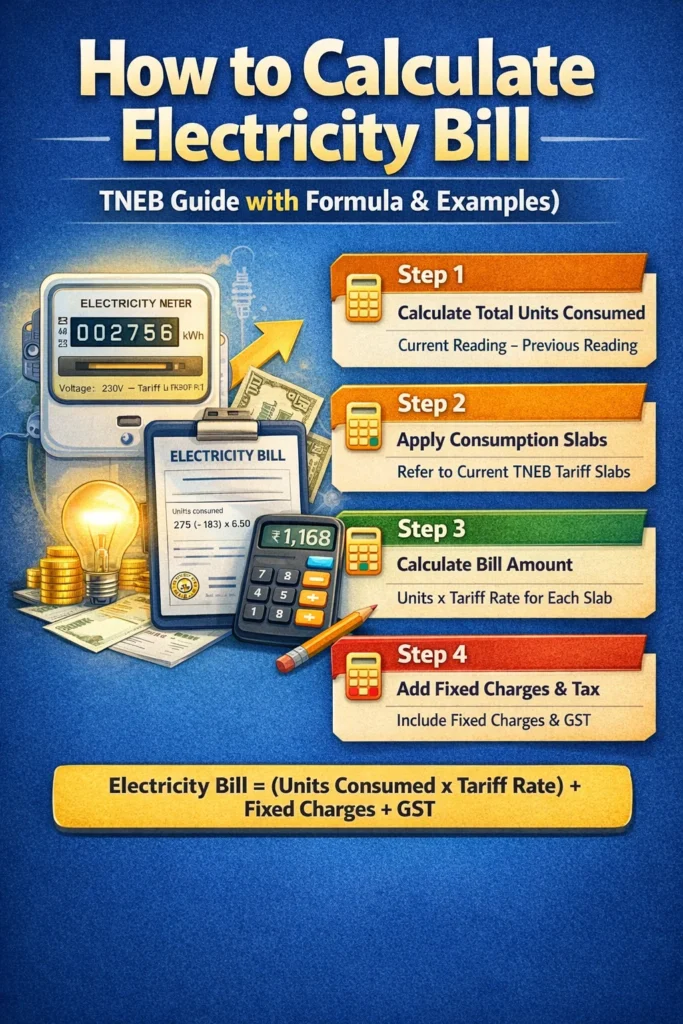
3. How to Calculate TNEB Electricity Bill (Step-by-Step)
The Tamil Nadu Generation and Distribution Corporation (TANGEDCO) calculates domestic bills on a bi-monthly (once every two months) basis. Here is how to calculate it manually:
- Find Your Consumption: Subtract your previous meter reading from your current meter reading to get the total units consumed.
- Apply the Free Subsidy: Deduct the first 100 units, as they are completely free for all domestic consumers in Tamil Nadu.
- Split into Slabs: Break down your remaining units according to the current TNEB tariff slabs.
- Multiply and Add: Multiply the units in each slab by their respective rates and add them together.
Doing this manually every two months can be confusing due to changing slab rules. You can quickly Calculate your exact TNEB bill using this calculator to get an instant, error-free breakdown. If you are looking for other financial and utility tools, visit our main calculator homepage.
4. TNEB Tariff Rates & Slab System
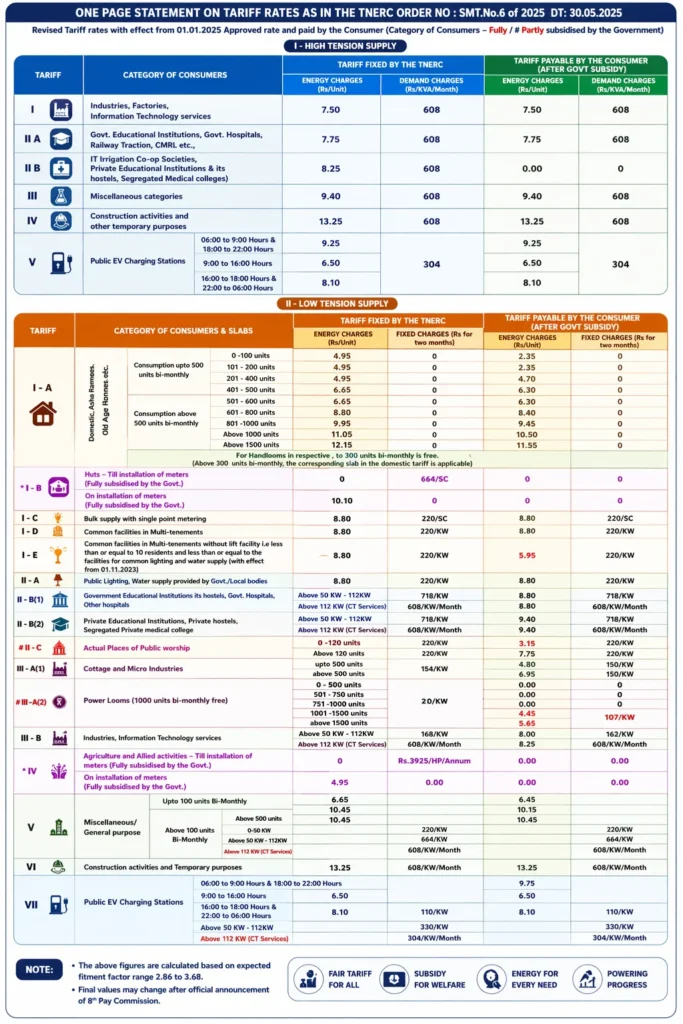
Below is a simplified reference table for the latest TNEB domestic tariff slabs. (Note: Rates are subject to periodic revisions by TANGEDCO).
TNEB Domestic Tariff Slabs (Bi-Monthly):
| Total Consumption | Unit Range | Rate per Unit |
| Up to 400 Units | 0 – 100 units 101 – 200 units 201 – 400 units | FREE ₹ 2.35 ₹ 4.70 |
| 401 to 500 Units | 0 – 100 units 101 – 200 units 201 – 400 units 401 – 500 units | FREE ₹ 2.35 ₹ 4.70 ₹ 6.30 |
| 501 to 600 Units (Subsidy drops) | 0 – 100 units 101 – 400 units 401 – 500 units 501 – 600 units | FREE ₹ 4.70 (Higher rate applied!) ₹ 6.30 ₹ 8.40 |
Notice the “Telescopic” penalty: The moment you consume 501 units, the cheaper ₹2.35 rate is removed entirely, and all units from 101 to 400 are charged at ₹4.70.
5. Sample Bill Calculation (Detailed Examples)
Let’s look at exactly how the tneb bill calculation works in real life.
Example A: 100 Units Consumed
- 0 to 100 units: 100 units × ₹0 (Free)
- Total Bill: ₹0
Example B: 250 Units Consumed
- 0 to 100 units: Free (₹0)
- 101 to 200 units: 100 units × ₹2.35 = ₹235
- 201 to 250 units: 50 units × ₹4.70 = ₹235
- Total Bill: ₹470
Example C: 500 Units Consumed
- 0 to 100 units: Free (₹0)
- 101 to 200 units: 100 units × ₹2.35 = ₹235
- 201 to 400 units: 200 units × ₹4.70 = ₹940
- 401 to 500 units: 100 units × ₹6.30 = ₹630
- Total Bill: ₹1,805
6. Additional Charges in Electricity Bill
When you look at your actual utility bill, you will notice a few extra line items beyond just the energy consumed:
- Fixed Charges: A set bi-monthly fee based on your “Contracted Load” (measured in kW). For many basic domestic connections under TNEB, this is highly subsidized or set to zero, but it applies heavily to commercial spaces.
- Meter Rent: A small recurring fee for the physical meter installed at your premises (if not purchased outright by you).
- Electricity Duty / Taxes: A government tax applied as a percentage of your total energy cost.
7. How to Reduce Your Electricity Bill
Lowering your consumption below the critical 500-unit slab can save you hundreds of rupees. Here are practical ways to do it:
- Upgrade to LEDs: Replace all old incandescent and CFL bulbs with energy-efficient LED lighting.
- Look for the Stars: When buying ACs, refrigerators, or washing machines, always opt for 4-star or 5-star appliances certified by the Bureau of Energy Efficiency (BEE).
- Service Your AC: A dirty air conditioner filter forces the compressor to work twice as hard, draining massive amounts of electricity.
- Unplug Idle Devices: TVs, microwaves, and chargers consume “vampire power” even when turned off but left plugged into the wall.
8. Aadhaar Linking for TNEB
To continue receiving the benefit of the first 100 free units and other government subsidies, the Tamil Nadu government has made it mandatory to link your Aadhaar card to your TNEB consumer number. Failing to do so may result in losing your subsidy or facing payment restrictions.
If you haven’t completed this process yet, Learn how to link Aadhaar with TNEB connection using our simple step-by-step guide.
9. FAQs
How is the electricity bill calculated?
Your electricity bill is calculated by subtracting your previous meter reading from your current reading to find the total units consumed. These units are then multiplied by the specific tariff rates set by your local electricity board, plus any fixed charges and taxes.
What is a unit in electricity?
A unit in electricity refers to one Kilowatt-hour (kWh). It represents the amount of energy required to run a 1000-watt appliance for one hour.
How to calculate TNEB bill?
To calculate your TNEB bill, take your bi-monthly unit consumption, subtract the 100 free units, and distribute the remaining units into TNEB’s telescopic slabs (e.g., 101-200, 201-400). Multiply the units in each slab by their specific rates and add them up.
What is a slab system?
A slab system is a tiered billing method where the cost per unit of electricity increases as your total consumption enters higher tiers (slabs). It is designed to encourage energy conservation by making heavy electricity usage more expensive.