
How to Use the Chinese Gender Calendar: Step-by-Step Guide
The Chinese Gender Calendar is a traditional chart that uses the mother’s Chinese lunar age and the lunar month of conception. The chart itself is simple. The tricky part is getting those two values right.
How does the Chinese Gender Calendar work?
Find the mother’s lunar age at conception, find the lunar month of conception, and then locate the cell where the two meet on the traditional chart. That cell gives the traditional Boy or Girl prediction.
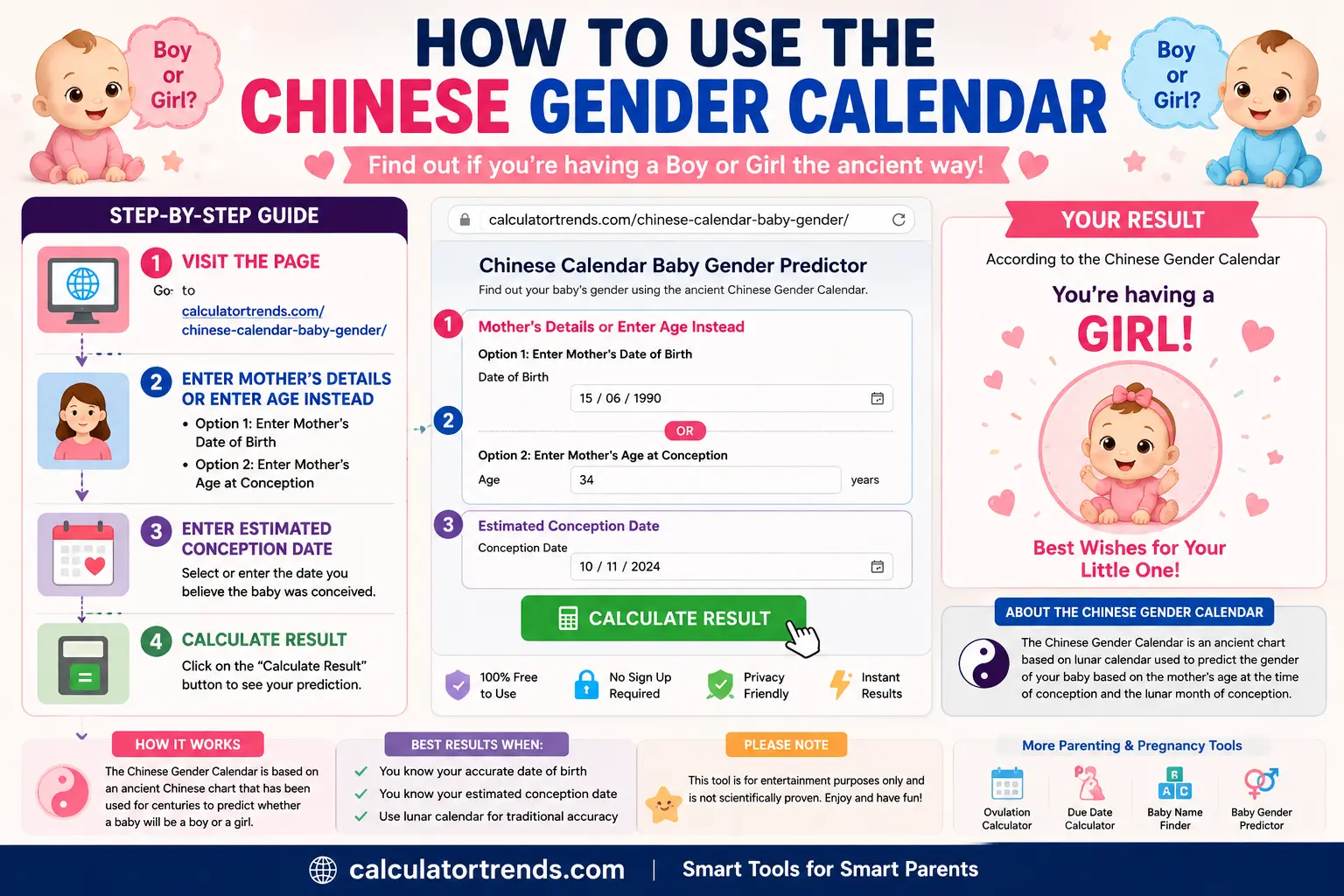
How Does the Chinese Gender Calendar Work?
The traditional Chinese Gender Calendar is basically a lookup table. The left side contains the mother’s lunar age. The top contains the lunar month of conception. The matching cell gives the traditional prediction.
| Chart part | What you need |
|---|---|
| Rows | Mother’s lunar age |
| Columns | Lunar month of conception |
| Result cell | Traditional Boy or Girl prediction |
You cannot simply use your normal age and the January–December calendar. The traditional chart uses the Chinese lunar calendar for both values.
The 4 Steps to Use the Chinese Gender Calendar
Find Lunar Age
Convert the mother’s birth date into the traditional lunar age used by the chart.
Find Lunar Month
Convert the estimated conception date to the Chinese lunar month.
Match the Chart
Find the lunar age row and lunar month column.
Read the Result
The intersecting cell gives the traditional prediction.
Step 1: Find the Mother’s Lunar Age
The first step is finding the mother’s lunar age at the time of conception. This is not always the same as the age shown on your ID or the age you normally use.
Traditional Chinese age counting starts at one at birth, and age traditionally changes around Chinese New Year rather than on the birthday. Because of that, lunar age can be one or two years different from Western age depending on the dates involved.
Why does this matter?
If you use the wrong age, you may end up on the wrong row of the chart. That can change the traditional prediction.
You can use our Lunar Age Calculator to work out the lunar age instead of calculating it manually.
Step 2: Find the Lunar Month of Conception
Next, you need the Chinese lunar month in which conception occurred. This is another common source of mistakes.
A Gregorian month such as March is not automatically lunar month 3. Chinese lunar months have different boundaries, so the exact date matters.
This is especially important around the start of a lunar year. A Gregorian month can overlap different lunar periods.
Step 3: Match Your Lunar Age With Your Lunar Month
Once you have both values, the chart lookup is simple.
Find 30 in the age column. Then find 5 across the top. The cell where they meet is the traditional prediction.
| Lunar Age | Month 1 | Month 2 | Month 3 | Month 4 | Month 5 | Month 6 | Month 7 |
|---|---|---|---|---|---|---|---|
| 28 | B | G | B | G | B | B | G |
| 29 | G | B | G | B | G | B | B |
| 30 | B | G | G | B | G | B | G |
| 31 | G | B | B | G | B | G | B |
In this example, the intersection of lunar age 30 and lunar month 5 is highlighted. The exact values depend on the traditional chart version used.
Step 4: Understand the Result
The result is normally shown as Boy or Girl. Some versions use B and G instead.
The visual style does not change the calculation. The result comes from the intersection of the selected row and column.
What the result actually means
It is a traditional prediction, not a medical result. There is no scientifically established formula that makes the chart able to determine a baby’s actual sex.
A Simple Example
Imagine a mother has a fictional birth date of June 15, 1993, and an estimated conception date of November 5, 2025.
- Convert the relevant dates into the Chinese lunar calendar.
- Determine the mother’s lunar age at conception.
- Determine the lunar month containing the conception date.
- Find the matching cell on the traditional chart.
For example, if the calculation produces a lunar age of 33 and lunar conception month 9, you would find age 33 on the left and month 9 across the top. The intersection gives the traditional prediction.
Why Chinese Lunar Age Is the Tricky Part
Many people assume the calculation is simply Western age + 1. Sometimes that shortcut appears to work, but it is not reliable for every date.
Chinese lunar age depends on the traditional age-counting system and the lunar calendar date involved. Around Lunar New Year, these differences can matter.
That is why it is better to convert the actual dates rather than blindly adding one year.
Common Mistakes When Using the Chinese Gender Calendar
1. Using Western age instead of lunar age
This can put you on the wrong row. Use the mother’s lunar age at conception.
2. Using the Gregorian month
March is not necessarily lunar month 3. Convert the conception date first.
3. Using your current age
The chart is based on the mother’s age at conception, not necessarily the age today.
4. Using the due date as the conception month
The traditional chart is based on the estimated conception date. A due date is later in the pregnancy and does not directly provide the lunar conception month.
5. Reading the wrong cell
Check both the age row and the lunar month column before reading the result.
How to Read the Chinese Gender Chart on Mobile
Traditional charts can be difficult to read on a phone because they contain many columns.
- Keep the age column visible.
- Scroll horizontally when needed.
- Check the lunar month number before reading the cell.
- Do not rely on color alone.
- Confirm the age and month before accepting the result.
A good calculator should also show the calculation details instead of giving you only a Boy or Girl label.
Chinese Gender Calendar 2026
The same basic process applies in 2026. The important difference is that Gregorian dates and Chinese lunar dates still do not line up one-to-one.
Lunar New Year in 2026 begins on February 17. That means the first lunar month does not begin on January 1.
So if your conception date is in 2026, do not choose the lunar month based only on the Gregorian month number. Convert the exact date first.
Is the Chinese Gender Calendar Accurate?
Short answer: The Chinese Gender Calendar is not a scientifically reliable way to predict a baby’s sex. Large research has found no predictive advantage over chance.
The method is popular, but popularity is not evidence of accuracy. A large population-based study involving more than 2.8 million singleton births found that the Chinese lunar calendar method performed no better than chance.
So why do people sometimes get the “right” answer? There are only two possible outcomes in the traditional prediction: Boy or Girl. A random guess can therefore appear correct quite often.
For a deeper look at the evidence, read our Lunar Age Calculator guide.
Traditional Chart vs. Scientific Test
| Chinese Gender Calendar | Medical testing |
|---|---|
| Traditional folklore | Medical practice |
| Uses lunar age and lunar month | Uses biological or clinical information |
| For curiosity and entertainment | Used for medical purposes |
| No proven predictive accuracy | Reliability depends on the specific test |
Frequently Asked Questions
What information do I need to use the Chinese Gender Calendar?
You generally need the mother’s date of birth and estimated conception date. These dates are then converted into the Chinese lunar calendar.
Do I use my normal age?
Traditional versions of the chart use the mother’s lunar age, not simply her Western age.
Do I use the birth month or conception month?
The traditional chart uses the lunar month of conception. It does not use the baby’s expected birth month.
Can I use the due date?
A due date is not the direct input used by the traditional chart. You first need an estimated conception date.
What if I do not know my exact conception date?
You can use your best estimate. Changing the date can sometimes change the lunar month and therefore the chart result.
Is the Chinese Gender Calendar scientifically proven?
No. Research has not shown it to be a reliable method for predicting a baby’s sex. It is best treated as traditional folklore and entertainment.
Why is my Chinese lunar age different from my normal age?
The traditional Chinese age system counts age differently from the modern Western system and follows the lunar calendar.
Does the Chinese Gender Calendar change every year?
The basic chart structure uses lunar age and lunar conception month. What changes from year to year is how Gregorian dates map to the lunar calendar.
The Easy Way to Use the Chinese Gender Calendar
The traditional chart itself is simple. The difficult part is converting the dates correctly.
You need:
- Mother’s lunar age
- Lunar month of conception
- The matching chart cell
Once those three pieces are correct, reading the traditional chart takes only a few seconds.