
How to Fill RTGS Form: Step-by-Step Guide for Beginners (2026)
To fill an RTGS form, write today’s date, your name and account number as the sender, then add the beneficiary’s full name, account number, IFSC code, bank name, and branch. Enter the transfer amount in both figures and words. Sign the form with your registered bank signature and submit it at your branch counter.
This guide walks you through every single field on the RTGS form — even if you have never filled one before. We keep things simple, practical, and beginner-friendly.
What is RTGS/NEFT Form?
An RTGS form is a paper slip you fill at your bank branch to transfer money electronically. RTGS stands for Real Time Gross Settlement. The money reaches the other person’s account almost instantly. As per RBI guidelines, RTGS is meant for amounts of ₹2 lakh and above.
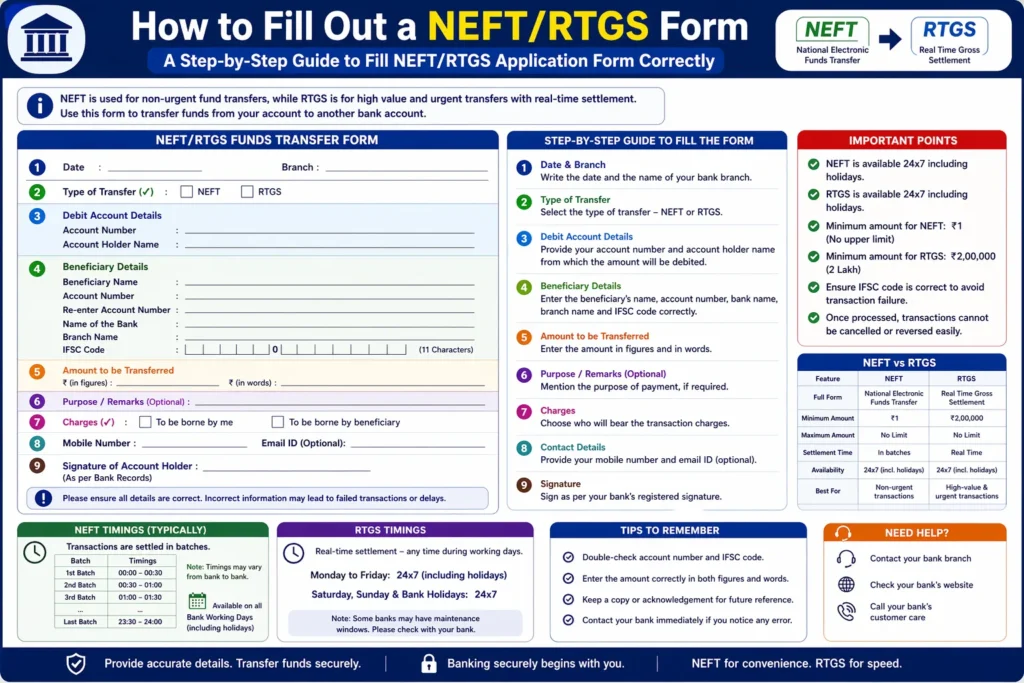
An NEFT form looks almost identical. NEFT stands for National Electronic Funds Transfer. The difference? NEFT processes transfers in batches (every 30 minutes), while RTGS settles each transaction individually in real time.
Both are types of fund transfer forms regulated by the Reserve Bank of India. Most banks — SBI, HDFC, ICICI — use a single combined form that works for both NEFT and RTGS. You simply tick which service you want.
Want a deeper explanation? Read our full page on what is RTGS.
When Do You Need This Form?
You need a NEFT/RTGS form when you want to send money from your bank account to someone else’s account — and you’re doing it offline at the branch instead of through net banking or a mobile app.
Common situations:
- Paying rent, tuition fees, or a contractor’s bill.
- Sending money to a family member in another city.
- Making a large business payment (above ₹2 lakh — RTGS territory).
- Your internet banking is not activated or temporarily down.
Quick rule: Amount below ₹2 lakh? The bank processes it through NEFT. Amount ₹2 lakh or more? RTGS kicks in. Some banks let you choose, but this is the standard cutoff.
Documents Required Before Filling the Form
Gather these before you walk into the branch. Missing even one detail means a wasted trip.
Your details:
- Bank passbook or account statement (you need your exact account number)
- A valid photo ID — Aadhaar card, PAN card, or passport
Beneficiary’s details (the person receiving money):
- Full name (exactly as registered with their bank)
- Account number
- Bank name and branch name
- IFSC code — an 11-character code that identifies the exact branch. Example: SBIN0001234. You can find this on the beneficiary’s cheque leaf, passbook, or their bank’s website.
Optional but helpful:
- A cancelled cheque from the beneficiary (makes it easy to copy details without errors)
- Your own cheque book (some branches ask for a cheque number as reference)
Double-check every digit. One wrong number in the account or IFSC code, and the money either bounces back or gets stuck for days.
Step-by-Step Guide to Fill RTGS/NEFT Form
Every Indian bank — SBI, HDFC, ICICI, PNB, Bank of Baroda — uses a similar layout. Fields might appear in slightly different order, but the information required stays the same. Here is each field explained.
Step 1: Date
Write the date you are submitting the form. Use DD/MM/YYYY format.
Example: 15/04/2026
Banks have a daily cutoff time for RTGS — usually around 4:30 PM on weekdays. Submit your form before that window closes if you want same-day transfer.
Step 2: Select NEFT or RTGS
Most combined forms have two checkboxes or circles at the top — one for NEFT, one for RTGS. Tick the correct one.
Transferring ₹2 lakh or more and need it instantly? Tick RTGS.
Smaller amount or no rush? Tick NEFT.
Step 3: Sender (Applicant) Name
Write your full name — the name linked to your bank account. Not a nickname. Not a shortened version.
Example: Rahul Kumar Sharma
This must match your bank’s KYC records. Any mismatch and the branch staff will send you back.
Step 4: Your Account Number
Enter your savings or current account number. This is the account from which the bank will debit (take out) the money.
Account numbers range from 10 to 16 digits depending on the bank. Copy it directly from your passbook — do not write from memory.
Step 5: Beneficiary Name
Write the receiver’s full name as it appears on their bank account.
Example: Priya Gupta
Even a small spelling mistake can cause rejection. If the beneficiary’s account says “Mohammed” and you write “Mohammad,” some banks flag it. Ask the receiver to share their name exactly as their bank has it.
Step 6: Beneficiary Account Number
Enter the receiver’s account number carefully. This is the most error-prone field on the entire bank transfer form.
Tip: Write each digit in a separate box if the form has boxes. After writing, read the number back to yourself digit by digit.
Step 7: Beneficiary Bank and Branch
Write the receiver’s bank name and the specific branch.
Example:
- Bank: HDFC Bank Ltd.
- Branch: Andheri East Branch, Mumbai
This information helps the system route money to the right destination, especially if two branches in the same city share similar names.
Step 8: IFSC Code
The IFSC code (Indian Financial System Code) is an 11-character alphanumeric code. Every bank branch in India has a unique one.
Format: First 4 letters = bank code. Fifth character = 0 (zero). Last 6 characters = branch code.
Example: HDFC0001234
Where to find it:
- Printed on the beneficiary’s cheque leaf (top left or bottom)
- On the bank’s official website under “Branch Locator”
- RBI’s IFSC search tool
Without the correct IFSC, the transfer simply will not go through. No exceptions.
Step 9: Amount
Fill this in two places on the form:
- In figures: ₹2,50,000/-
- In words: Rupees Two Lakh Fifty Thousand Only
Always end the words with “Only” — this prevents anyone from adding extra amounts after your text.
For RTGS, the minimum is ₹2,00,000. There is no upper cap set by RBI, though individual banks may set their own maximum. NEFT has no minimum amount.
Want to check how much your bank charges for the transfer? Use RTGS calculator to estimate fees before you fill the form.
Step 10: Purpose of Remittance
Some forms include this field. Write a brief reason.
Examples: Personal Transfer, Loan Repayment, Property Payment, Salary Payment.
RBI requires banks to record the purpose for high-value transactions. Keep it honest and straightforward.
Step 11: Signature
Sign at the designated spot using blue or black ink. Your signature must match the one your bank has on file (the specimen signature from when you opened the account).
Unsigned forms get rejected immediately. If your signature has changed over the years, update it at the branch first.
Some forms also have a space for your mobile number — fill it in so the bank can send you an SMS confirmation once the transfer goes through.
Sample Filled RTGS Form (Field-by-Field)
Here is a realistic example of a completed SBI RTGS form. Use this as a reference while filling your own.
| Field | What to Write | Why |
|---|---|---|
| Date | 15/04/2026 | Tells the bank when you submitted |
| Type | ☑ RTGS ☐ NEFT | Amount is above ₹2 lakh |
| Applicant Name | Rahul Kumar Sharma | Must match your bank account name |
| Applicant Account No. | 20345678912 | Your SBI account — source of funds |
| Beneficiary Name | Priya Gupta | Receiver’s name per their bank records |
| Beneficiary Account No. | 98765432109 | Their HDFC account number |
| Beneficiary Bank | HDFC Bank Ltd. | Full official bank name |
| Branch | Andheri East, Mumbai | Specific branch — not just city |
| IFSC Code | HDFC0001234 | 11 characters — identifies exact branch |
| Amount (Figures) | ₹2,50,000/- | Numeric value with rupee symbol |
| Amount (Words) | Rupees Two Lakh Fifty Thousand Only | Spelled out completely, ends with “Only” |
| Purpose | Personal Remittance | Brief, honest reason |
| Signature | (your registered signature) | Must match bank records — blue/black pen |
| Mobile No. | 98XXXXXX12 | For SMS confirmation |
For SBI-specific timings, limits, and charges, check our SBI RTGS details page.
Disclaimer: Form layouts differ slightly across banks. Always refer to the latest version from your bank’s official website or branch counter.
Download RTGS/NEFT Forms
Print these official forms at home before visiting the branch. Saves time standing in line.
- Download HDFC RTGS/NEFT form — Combined NEFT/RTGS form in PDF format.
- Download SBI RTGS form — Standard requisition form for SBI customers.
- Download Central Bank RTGS form — For Central Bank of India account holders.
- Download Bharat Co-operative Bank RTGS form — Co-operative bank version.
For ICICI Bank, search “RTGS NEFT form” on the ICICI official website — they update their form portal frequently.
Print on A4 paper. Use only the latest version of the form. Banks occasionally update fields based on new RBI circulars, so avoid using forms saved from months ago.
Common Mistakes to Avoid
These errors cause the most rejections and delays at the counter. Read each one carefully.
1. Wrong IFSC code.
Even one wrong character sends money to the wrong branch — or nowhere at all. Always verify the IFSC from the beneficiary’s cheque or their bank’s website. Never rely on Google search results alone.
2. Mismatched beneficiary name.
The name you write must match the receiver’s bank records exactly. “Mohd.” vs “Mohammed” vs “Muhammad” — banks treat these as different names.
3. Amount in words left blank or incomplete.
Writing “2,50,000” in figures but leaving the words section empty? Rejected. The bank needs both. Spell out the full amount and add “Only” at the end.
4. Unsigned form.
Easy to forget when you’re in a rush. No signature means the form goes straight back to you.
5. Submitting after cutoff time.
RTGS cutoff is usually 4:30 PM on weekdays. NEFT batches run until later, but weekend processing depends on the branch. Submit early.
6. Using an outdated form.
RBI updates regulations periodically. A form from 2022 might be missing new mandatory fields. Download a fresh copy every time.
Tips for Faster Processing
- Fill the form at home. Download, print, and complete it before reaching the branch. Walk straight to the submission counter.
- Carry a cancelled cheque from the beneficiary. Branch staff sometimes ask for verification, especially for first-time large transfers.
- Visit during off-peak hours. Early mornings (10–11 AM) on mid-month weekdays are usually less crowded than month-end or lunch hours.
- Use blue or black ballpoint pen. Gel pens smudge. Pencil is not accepted.
- Ask for the UTR number. After submission, the bank generates a Unique Transaction Reference number. Note it down — you can use it to track the transfer status.
- Estimate charges beforehand. Banks charge ₹5 to ₹50 depending on the amount and type. Use the SBI RTGS charges calculator to know exact fees before your visit.
For frequent transfers, consider activating internet banking or your bank’s mobile app. Online NEFT and RTGS are available 24/7, and most banks charge zero fees for online fund transfers as per RBI’s 2019 directive.
FAQs
1. What is the difference between NEFT form and RTGS form?
NEFT transfers money in batches every 30 minutes and works for any amount. RTGS transfers money instantly and requires a minimum of ₹2 lakh. Most banks use one combined form — you just tick which service you want.
2. Where can I get a blank RTGS form?
Pick one up at your bank’s branch counter for free. You can also download SBI RTGS form or your specific bank’s form from their official website and print it on A4 paper.
3. Is IFSC code mandatory on the RTGS form?
Yes. As per RBI rules, the 11-character IFSC code is compulsory for all electronic fund transfers — both NEFT and RTGS. The transfer cannot be processed without it.
4. What is the minimum and maximum amount for RTGS?
Minimum: ₹2,00,000. There is no maximum limit set by RBI, though your bank may have its own per-day cap. For NEFT, there is no minimum — you can transfer even ₹1.
5. How long does an RTGS transfer take after submitting the form?
RTGS transfers are processed in real time during banking hours. If you submit before the 4:30 PM cutoff, the beneficiary receives money within 30 minutes — often within minutes. NEFT takes up to 2 hours.
6. Can I fill the HDFC RTGS form PDF on my computer?
The PDF is designed for printing and manual filling. For digital transfers, use HDFC net banking or the HDFC mobile app instead of a paper form.
7. What happens if I write the wrong beneficiary account number?
Contact your bank immediately. If the wrong account number does not exist, the money bounces back in 2–3 working days. If it exists and belongs to someone else, recovery is harder — it can take 7–14 days and requires the other bank’s cooperation. As per RBI, your bank must assist in the recall process.
8. Are NEFT and RTGS transfers free?
Online NEFT and RTGS are free at most banks (RBI waived charges in 2019). Offline transfers using a paper form may attract charges of ₹5 to ₹50 depending on the amount and your bank’s policy. Check with the SBI RTGS charges calculator for exact numbers.
Conclusion
Filling a NEFT or RTGS form takes less than five minutes once you know what goes where. Keep the beneficiary’s account number and IFSC code handy, double-check every digit, sign clearly, and submit before the cutoff. That covers 90% of what you need to do right. For estimating transfer costs, use RTGS calculator before your next branch visit.