
What is RTGS in Banking? Full Guide to RTGS Meaning, Process, Limits, Charges & More (2026)
RTGS is Real Time Gross Settlement — an electronic payment system run by the Reserve Bank of India. It transfers funds instantly and individually for high-value transactions of ₹2 lakh and above. There is no upper limit set by RBI. The system runs 24×7, including weekends and holidays. It is the fastest way to send large sums between Indian bank accounts.
Data accuracy note: All information sourced from official RBI publications and verified banking portals. Charges and daily limits vary by bank — always confirm with your branch or net banking portal before transacting.
RTGS in Simple Words
Say you need to send ₹5 lakh to someone right now. Not tomorrow. Not after a batch clears. Right now.
RTGS does exactly that. Money leaves your account and lands in the receiver’s account within seconds. No middleman holds it overnight. No clearing house bundles it with other transfers.
Think of it like handing cash directly to someone — except it happens electronically, between two different banks, secured by RBI’s infrastructure.
A cheque can take two to three working days. NEFT processes transfers in batches every half hour. RTGS skips all of that. Each transaction settles on its own, the moment you hit submit.
In India, people use RTGS for property purchases, business vendor payments, loan disbursements, and salary credits above ₹2 lakh. Any situation where delay costs money or trust, RTGS is the tool banks recommend.
RTGS Full Form
RTGS stands for Real Time Gross Settlement.
Three words, three meanings:
- Real Time — the transfer executes immediately. No queue. No waiting window. Seconds, not hours.
- Gross — each transaction is processed individually. Your ₹5 lakh transfer does not get lumped together with someone else’s ₹3 lakh transfer. They settle separately.
- Settlement — the funds reach finality. Once settled, the money belongs to the receiver. No reversal by the system.
RBI introduced RTGS in India on March 26, 2004. Since then, the system has scaled to process trillions of rupees in daily volume. In December 2020, RBI made RTGS available round the clock — 24 hours a day, 365 days a year.
For the official FAQ, visit RBI’s RTGS information page.
How RTGS Works (Step-by-Step)
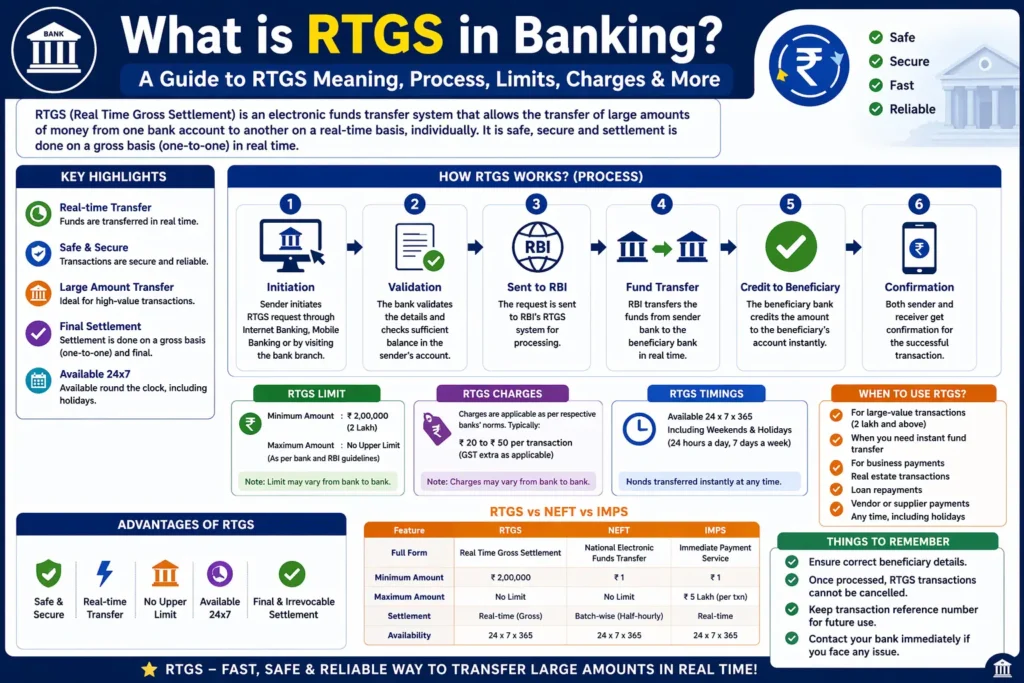
The RTGS process involves six steps. You can do this through net banking, a mobile app, or at a bank branch with a physical form.
Step 1 — Log in to your bank account.
Open your bank’s net banking portal or mobile app. Make sure your account has enough balance to cover the transfer amount plus any applicable charges.
Step 2 — Add beneficiary details.
Navigate to Fund Transfer → Add Beneficiary. Enter the receiver’s full name (as per their bank records), account number, and IFSC code. The IFSC code is an 11-character alphanumeric code that identifies the receiver’s specific bank branch. You will find it on any cheque leaf or on the bank’s website.
Most banks require a cooling period of 30 minutes to 24 hours after adding a new beneficiary before you can transfer funds. This is a security measure.
Step 3 — Select RTGS as the transfer mode.
Under Fund Transfer, choose RTGS. Not NEFT, not IMPS. Select the beneficiary you just added.
Step 4 — Enter the amount.
Minimum is ₹2 lakh. RBI sets no maximum, but your bank may impose a daily cap — commonly ₹25 lakh to ₹50 lakh for individual accounts through online channels. Branch transfers may allow higher amounts.
Step 5 — Authenticate and submit.
Review all details carefully. Confirm using OTP, transaction password, or biometric authentication depending on your bank’s security setup. Once submitted, the request goes to RBI’s RTGS system.
Step 6 — Settlement and confirmation.
RBI’s system processes the transfer in real time. The receiver’s bank credits the amount within seconds to a few minutes. You receive an SMS or email confirmation with a UTR number (Unique Transaction Reference). Save this number — it is your proof of transfer and essential for any dispute resolution.
The entire process, from login to confirmation, typically takes 2 to 30 minutes depending on your bank’s interface and server load.
Real-Life Example
Ravi is buying a flat in Pune for ₹32 lakh. The seller, Meena, banks with HDFC. Ravi banks with SBI.
Ravi logs into SBI net banking. He has already added Meena as a beneficiary using her HDFC account number and IFSC code (HDFC0001234 — the code for her specific branch).
He selects RTGS, enters ₹32,00,000, reviews the details, and confirms with an OTP sent to his registered mobile number.
Within 40 seconds, Meena receives an SMS from HDFC: ₹32,00,000 credited. Ravi gets his own confirmation with the UTR number. The registration office accepts the UTR as proof of payment.
No demand draft. No cheque clearing period. No risk of the cheque bouncing three days later.
Beneficiary Meaning in RTGS
In RTGS, the beneficiary is the person or entity receiving the money. Simple as that.
Before you can send funds via RTGS, you must register the beneficiary in your bank account. This requires three pieces of information:
- Beneficiary name — must match the name on their bank account exactly. “Meena Sharma” is not the same as “M. Sharma” in most banking systems.
- Account number — the receiver’s bank account number.
- IFSC code — identifies the receiver’s bank and branch.
Once registered, the beneficiary stays saved in your account for future transfers. Banks verify these details to prevent fraud and misdirected payments.
The beneficiary receives the full amount. RBI does not deduct any fee from the receiving end. Charges, if any, are borne by the sender.
RTGS vs NEFT vs IMPS
India has three main electronic fund transfer systems managed or overseen by RBI. Choosing the right one depends on your transfer amount, urgency, and method.
| Feature | RTGS | NEFT | IMPS |
|---|---|---|---|
| Full Form | Real Time Gross Settlement | National Electronic Funds Transfer | Immediate Payment Service |
| Managed By | RBI | RBI | NPCI |
| Minimum Amount | ₹2 lakh | ₹1 (no minimum) | ₹1 (no minimum) |
| Maximum Amount | No RBI limit (bank may cap) | No RBI limit | ₹5 lakh per transaction |
| Speed | Real-time (seconds) | Batched every 30 minutes (now 24×7) | Real-time (seconds) |
| Availability | 24×7×365 | 24×7×365 | 24×7×365 |
| Settlement Type | Gross (individual) | Net (batched together) | Real-time (individual) |
| Best For | High-value urgent transfers | Regular payments of any size | Small instant transfers via mobile |
| Typical Charges | ₹20–50 (online) | ₹0–25 | ₹5–15 |
| Requires IFSC? | Yes | Yes | No (uses MMID or account + IFSC) |
RTGS vs NEFT: Use RTGS when the amount is ₹2 lakh or more and you need instant confirmation. NEFT works for any amount but processes in half-hourly batches — your transfer might wait up to 30 minutes even though the system runs 24×7.
RTGS vs IMPS: IMPS is capped at ₹5 lakh and designed for quick mobile transfers. RTGS has no upper ceiling and is built for serious, high-value movement of funds. For anything under ₹2 lakh, IMPS or NEFT is the practical choice since RTGS will not allow it.
Key Features of RTGS
- Instant settlement. Funds transfer in real time, not in batches or after a waiting period.
- High-value focus. Designed specifically for transactions of ₹2 lakh and above.
- No upper limit from RBI. You can transfer ₹2 crore or ₹20 crore — the system does not cap it. Individual banks set their own daily limits for security reasons.
- 24×7×365 availability. Works on Sundays, Diwali, Independence Day — every single day since RBI’s December 2020 update.
- Individual processing. Each transaction is independent. One failed transfer does not affect another.
- UTR tracking. Every transaction generates a Unique Transaction Reference number for end-to-end traceability.
- RBI regulated. Falls under direct oversight of the Reserve Bank of India, with strict security and operational standards.
Benefits of RTGS
For individuals:
Property purchases close faster. Loan repayments reach lenders without cheque-clearing anxiety. Large gifts or family transfers happen in minutes instead of days.
For businesses:
Vendor payments settle immediately, strengthening supplier relationships. Payroll for senior employees above ₹2 lakh processes without batch delays. Cash flow becomes predictable — you know exactly when money leaves and arrives.
For the banking system:
Gross settlement reduces systemic risk. If one transaction fails, it does not drag down an entire batch. RBI can monitor high-value flows in real time for regulatory oversight.
Compared to physical methods:
Eliminates the risk of cheque bouncing, demand draft loss in transit, and the security hazard of carrying large cash amounts. A ₹50 lakh demand draft lost in the mail is a nightmare. A ₹50 lakh RTGS transfer confirmed by UTR in 20 seconds is not.
RTGS Charges, Limits & Timings in India
Limits
| Parameter | Detail |
|---|---|
| Minimum per transaction | ₹2,00,000 |
| Maximum per transaction (RBI) | No limit |
| Maximum per day (bank-imposed, typical) | ₹10 lakh – ₹50 lakh (online), higher at branch |
As per RBI guidelines, there is no ceiling on RTGS transaction amounts. However, individual banks impose daily transfer limits through net banking and mobile apps for fraud prevention. Branch-initiated RTGS transfers often allow higher amounts with additional verification.
Timings
RTGS operates 24 hours a day, 7 days a week, 365 days a year since December 14, 2020. Earlier, it ran only on banking days during fixed windows. That restriction no longer applies.
Charges
Charges depend on the sending bank. Receiving RTGS funds is free.
| Amount Slab | Typical Online Charge | Typical Branch Charge |
|---|---|---|
| ₹2 lakh – ₹5 lakh | ₹0 – ₹25 | ₹25 – ₹50 |
| Above ₹5 lakh | ₹25 – ₹50 | ₹50 – ₹55 |
Disclaimer: These are indicative ranges. Actual charges vary by bank and change periodically. Always verify current fees on your bank’s website or at the branch before initiating a transfer.
SBI customers can check SBI RTGS charges specifically.
When to Use RTGS
RTGS makes sense in these situations:
- Property transactions. Buying a house, flat, or land where the seller needs confirmed funds before signing documents.
- Business-to-business payments. Settling invoices above ₹2 lakh with suppliers or contractors who demand immediate payment.
- Loan closures. Paying off a home loan, car loan, or business loan in full where delay could mean extra interest for another day.
- Investment deposits. Transferring large sums to a brokerage, mutual fund house, or fixed deposit account where timing affects returns.
- Emergency family transfers. Medical expenses, wedding costs, or any urgent personal need above ₹2 lakh.
When NOT to use RTGS:
If the amount is below ₹2 lakh, the system will reject your transaction. Use NEFT or IMPS instead. For recurring small payments like monthly rent or utility bills, UPI or NEFT auto-pay is more practical.
If you prefer to initiate RTGS offline at a branch, you can download the RTGS form from our site and fill it in advance to save time.
Safety and Security
RTGS is one of the most secure fund transfer methods in India. RBI’s infrastructure uses encrypted messaging, multi-level authentication, and real-time monitoring. But the system’s safety also depends on what you do at your end.
Protect yourself:
- Double-check beneficiary details before submitting. A wrong account number or IFSC code can send your money to the wrong person. Recovery in such cases is difficult and slow.
- Use strong, unique passwords for your net banking and mobile banking apps. Do not reuse passwords from other websites.
- Never share your OTP, password, or UTR number with anyone claiming to be from the bank. Banks never ask for these over phone calls or messages.
- Transact only on secure networks. Avoid public Wi-Fi for banking. Use your mobile data or home broadband.
- Enable transaction alerts. SMS and email notifications let you catch unauthorized activity within minutes.
- Report errors immediately. If an RTGS transfer goes wrong — wrong amount, wrong beneficiary — contact your bank’s customer care within 30 minutes. The faster you act, the higher the chance of reversal before the receiver withdraws.
As per RBI guidelines, banks must resolve RTGS-related complaints within a defined timeframe. If your bank does not respond, you can escalate to the RBI Ombudsman.
For additional tools to verify transfer details and calculate charges before sending, use our banking calculators.
Common Mistakes to Avoid
Entering the wrong IFSC code.
This is the most frequent error. A mistyped IFSC sends your request to the wrong bank branch. The transaction either bounces back (costing time) or lands in a wrong account (costing time and stress). Copy the IFSC from the receiver’s cheque book or verify it on the bank’s official site.
Trying to send less than ₹2 lakh.
RTGS has a hard minimum. Submitting ₹1.99 lakh will fail outright. If your amount is below ₹2 lakh, switch to NEFT or IMPS.
Not checking your available balance.
Your account needs the transfer amount plus applicable charges. If your balance is ₹2,00,000 and the bank charges ₹25, the transaction will fail. Keep a small buffer.
Misspelling the beneficiary name.
Some banks reject transfers if the name does not match their records exactly. Use the full legal name as registered with the receiver’s bank. Avoid abbreviations unless the account itself uses them.
Ignoring the UTR number.
People close the confirmation screen without noting the UTR. This 16-22 character reference is your only proof if a dispute arises. Screenshot it or save the confirmation email.
Assuming instant credit in all cases.
While RTGS is real-time on RBI’s side, the receiving bank may take a few minutes to credit the beneficiary’s account due to internal processing. Weekdays during banking hours are fastest. Late-night transfers on holidays might take slightly longer to reflect, even though settlement is instant.
Frequently Asked Questions
What is the full form of RTGS?
Real Time Gross Settlement.
What does RTGS mean in banking?
RTGS is an electronic system that transfers funds instantly between bank accounts for amounts of ₹2 lakh and above. It is managed by the Reserve Bank of India and operates 24×7.
Can you give a simple RTGS example?
You owe your contractor ₹8 lakh for renovation work. You log into net banking, select RTGS, enter his account number and IFSC, submit with OTP. He receives ₹8 lakh within a minute. Done.
How long does an RTGS transfer take?
Seconds to a few minutes in most cases. The RBI side settles instantly. Credit to the beneficiary account depends on the receiving bank’s processing speed.
What is the minimum and maximum amount for RTGS?
Minimum is ₹2 lakh per transaction. RBI has set no maximum. Banks individually cap daily online limits, typically between ₹10 lakh and ₹50 lakh for retail customers.
Is RTGS available on holidays?
Yes. Since December 2020, RTGS runs 24 hours a day, every day of the year, including national holidays and bank holidays.
What is the difference between RTGS and NEFT?
RTGS settles each transaction individually in real time for ₹2 lakh and above. NEFT processes transfers in half-hourly batches with no minimum amount. Both run 24×7.
What happens if I enter wrong details in RTGS?
If the account number and IFSC do not match any valid account, the transfer bounces back to your account — usually within a few hours to one working day. If the details accidentally match a different valid account, recovery requires your bank to contact the receiving bank, and there is no guarantee of reversal. Always verify before submitting.
Conclusion
- RTGS stands for Real Time Gross Settlement — India’s system for instant, high-value electronic fund transfers.
- Minimum amount is ₹2 lakh. No upper limit set by RBI.
- Operates 24×7×365 since December 2020.
- Each transaction settles individually and instantly — no batching, no netting.
- Charges range from ₹0 to ₹55 depending on bank and channel. Receiving is free.
- Always verify beneficiary name, account number, and IFSC before submitting.
- Save your UTR number for every transaction.
- Use NEFT or IMPS for amounts below ₹2 lakh.
- For detailed bank-wise charges, limits, and offline forms, explore our banking calculators and tools.